
TL;DR

Get home appliances delivered free with Prime
- Fast, free delivery on millions of items
- Prime Video, Amazon Music and more included
- Member-only deals all year
A team in the Netherlands has developed a bike-powered plastic shredder to process 3D printer waste. This demonstration aims to show the potential for sustainable recycling, though scaling remains a challenge.
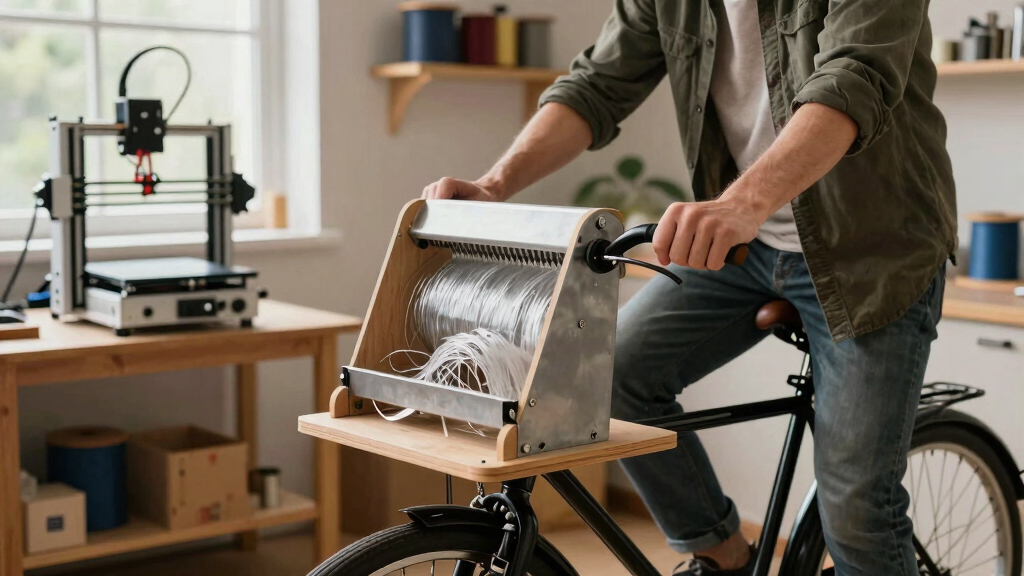
A researcher and students in the Netherlands have built a human-powered plastic shredder that uses a stationary bike to generate the torque needed to shred 3D printer waste, demonstrating an innovative, sustainable recycling method.
The shredder is powered by a stationary bike connected to a gear reduction system, a large flywheel, and safety covers, enabling users to turn human effort into enough rotational force to process plastic waste reliably. The setup includes a hopper for waste input and a bin for shredded material, making the process accessible and educational.
The team’s goal is to convert shredded plastic into filament for 3D printing or use it in compression molding, aiming to close the recycling loop at a small scale. The project emphasizes the importance of hands-on demonstrations in understanding the challenges of plastic recycling, especially in terms of energy and scale.
Potential Impact of Human-Powered Recycling Demonstration
This project highlights the feasibility of low-energy, DIY recycling methods, which could inspire community-level initiatives and educational programs. While not a scalable solution for large-scale recycling, it underscores the need for accessible, sustainable approaches to plastic waste management and raises awareness about the complexities involved in recycling at scale.
manual plastic shredder for 3D printing waste
As an affiliate, we earn on qualifying purchases.
As an affiliate, we earn on qualifying purchases.
Limitations and Goals of DIY Plastic Recycling Tools
Plastic waste from 3D printing is a growing concern, as traditional recycling methods often require energy-intensive processes and infrastructure. The development of a manually powered shredder reflects ongoing efforts to make recycling more accessible and educational. However, scaling such solutions to industrial levels remains a significant challenge, with current methods still limited in efficiency and capacity.
This project is part of a broader movement to explore sustainable, community-based approaches to plastic waste, emphasizing the importance of innovation, education, and practical demonstrations.
“The bike-powered shredder proves that with simple mechanical systems, we can turn human effort into meaningful plastic processing, at least on a small scale.”
— an anonymous researcher
As an affiliate, we earn on qualifying purchases.
Challenges in Scaling Human-Powered Recycling
It is not yet clear how practical or efficient this bike-powered shredder could be for larger-scale recycling efforts. Questions remain about the durability of the system, the volume of waste it can process, and whether similar manual methods can be adapted for industrial use.
small-scale plastic recycling machine
As an affiliate, we earn on qualifying purchases.
As an affiliate, we earn on qualifying purchases.
Next Steps for Demonstration and Scaling Efforts
The team plans to refine the shredder’s design, test the quality of the shredded material for reuse, and explore ways to integrate this approach into educational programs or small-scale recycling initiatives. Further research is needed to evaluate its potential for broader application.
As an affiliate, we earn on qualifying purchases.
Key Questions
Can this bike-powered shredder process large amounts of plastic waste?
Currently, the shredder is designed for small-scale, educational demonstrations and is not suitable for large-scale waste processing.
What types of plastic waste can it shred?
It is primarily designed to shred 3D printer filament waste, but the design could potentially handle other similar plastics.
Is this method energy-efficient compared to traditional shredders?
As a human-powered system, it consumes no external electricity, making it highly energy-efficient at small scale, but less practical for high-volume processing.
Could this be scaled up for industrial recycling?
Scaling up would require significant modifications, and it remains uncertain whether manual power can meet industrial throughput demands.
Source: Hackaday
Cold & flu season Picks
humidifiers
As an affiliate, we earn on qualifying purchases.