TL;DR

Get home appliances delivered free with Prime
- Fast, free delivery on millions of items
- Prime Video, Amazon Music and more included
- Member-only deals all year
A TikTok creator identified as mellcasey used shower-curtain fabric, scissors and hot glue to customize a pleated lampshade. Hunker reported that the shade can be coordinated with a bathroom window using the same curtain, though the source does not provide the creator’s project cost or detailed safety testing.
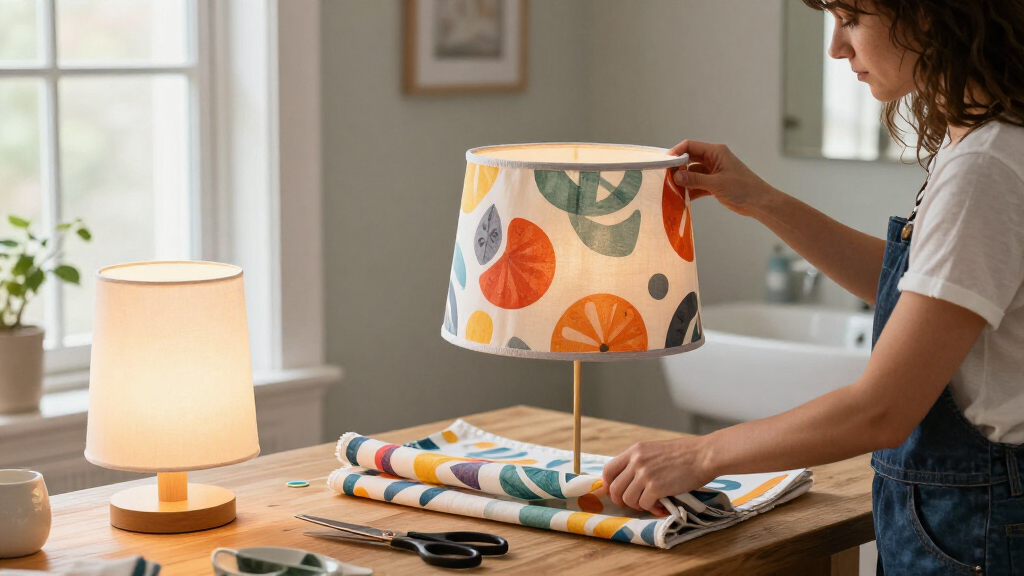
A TikTok creator identified as mellcasey demonstrated how to turn shower-curtain fabric into a custom lampshade, using scissors and hot glue to cover a pleated shade. Hunker reported that the idea can help coordinate a lamp with a bathroom window dressed with the same curtain, offering a do-it-yourself alternative to buying a made-to-order shade.
The project uses a shower curtain, pleated lampshade, scissors and hot-glue gun, according to Hunker’s account of the video. The curtain is cut slightly larger than the shade so it can cover the surface; extra fabric can then be trimmed or folded underneath. A slim tool, such as the end of a paintbrush, can help press the material into the grooves between the pleats.
The pleats matter because they allow the fabric pattern to remain visible across the shade, Hunker said. A plain, non-pleated shade can also be used, while an older or thrifted shade may offer a lower-cost base and hide stains or surface damage. The report does not say what curtain or lampshade mellcasey used, or how long her own project took.
Using the same curtain at a bathroom window and on a lamp can make the pieces look coordinated. Hunker cited an example of a pleated shade priced at just under $25 and said custom shades from companies can cost more than $100. Those figures are examples in the report, not a confirmed total cost for the creator’s project; the curtain, tools and shade all affect the final expense.
A Low-Cost Route to Coordinated Decor
The idea gives renters and homeowners another way to adapt an existing household item rather than search for a shade in an exact color or pattern. For readers who already own a suitable curtain or lamp, reusing materials may reduce the cost of creating a coordinated look. Whether it is cheaper than buying a ready-made shade depends on what supplies are already available and the price of the chosen fabric.
The project also shows how a bathroom fixture can be styled as part of a room’s decor rather than treated only as a practical object. Hunker noted that lamps can add layered lighting in bathrooms, where overhead fixtures may not provide the preferred atmosphere. The article presents that as a design rationale, not evidence that the approach is suitable for every bathroom or lamp.
There is a practical limit: the fabric and adhesive sit close to a light source. Hunker advises using a low-heat bulb, such as an LED, to reduce the risk of heat damaging the materials. The report does not describe testing the finished shade, so the project should not be read as a guarantee of fire safety or compatibility with every lamp.
shower curtain fabric for lampshade
As an affiliate, we earn on qualifying purchases.
As an affiliate, we earn on qualifying purchases.
How the Curtain Becomes a Shade
The core technique is a cover applied to an existing lampshade, rather than construction of a shade from scratch. Hunker describes cutting the curtain larger than the shade, attaching it with hot glue and pressing it into the pleats before dealing with the excess. The method relies on the shape of the shade underneath to create the finished form.
Hunker also mentioned using shower curtains as window drapes as a related decorating idea. In the example described, pairing that window treatment with a lamp shade made from the same curtain creates a matching set. The article says fabric curtains may produce a more attractive result and notes that an old curtain could be repurposed, but it does not compare materials or provide durability results.
For a more extensive alternative, the report says a person could make a lampshade from scratch. That is separate from the TikTok project, which starts with a ready-made shade and changes its appearance.
“She uses a shower curtain to upgrade a plain lampshade into a custom piece that matches the furnishings in her bathroom.”
— Hunker, reporting on mellcasey’s TikTok
As an affiliate, we earn on qualifying purchases.
Project Cost and Safety Details
The source does not identify the curtain’s material, the lamp’s specifications, the bulb used in the video or the creator’s total project cost. It also does not say whether the finished shade was tested for heat exposure or how it performed over time. The cited prices are examples, and the actual cost will vary with the materials selected.
Hunker recommends a low-heat LED bulb but does not provide guidance for particular lamp models, clearances or local safety requirements. Readers should follow the lamp manufacturer’s instructions and avoid using a covering that interferes with ventilation or contacts a hot bulb. The report does not establish that every shower curtain or adhesive is suitable for use on a lampshade.
As an affiliate, we earn on qualifying purchases.
Choosing Materials Before You Start
The report describes a DIY method rather than a scheduled product launch or follow-up project, and it gives no indication of what mellcasey plans to do next. For anyone attempting the idea, the next steps are to choose a shade with a shape that suits the fabric, check that enough curtain material is available, and confirm the lamp’s bulb and operating instructions before attaching anything.
Hunker’s guidance is to cut the fabric with extra room, secure it to the shade and press it carefully into the pleats. Any material that interferes with the shade’s fit or the lamp’s normal operation should not be used. The source does not offer a tested pattern or measurements, so the amount of fabric and the finish will depend on the individual shade.
As an affiliate, we earn on qualifying purchases.
Key Questions
What materials does the shower-curtain lampshade project use?
Hunker lists a shower curtain, pleated lampshade, scissors and hot-glue gun. A slim tool, such as a paintbrush handle, can help tuck fabric into the pleats.
Does the lampshade have to be pleated?
No. Hunker says the approach can also be used on a regular lampshade. Pleats may help display a design in the fabric, while an existing or thrifted shade can be reused as the base.
How much does the project cost?
The source does not give the total cost of mellcasey’s project. Hunker cites one pleated shade priced just under $25 and says some custom shades cost over $100, but the final expense depends on the materials and supplies.
Is it safe to cover a lampshade with curtain fabric?
Hunker advises using a low-heat bulb, such as an LED, to reduce the risk of damage to the fabric or glue. The report does not provide safety testing for the finished shade, so follow the lamp maker’s instructions and do not obstruct ventilation or place fabric against a hot bulb.
Source: rss
Fall yard work Picks
leaf blowers
As an affiliate, we earn on qualifying purchases.