This checklist is for homeowners and renters comparing products that might play a role in a home energy setup. The picks span smart plugs, monitors, power stations, surge protection, light switches, and battery backup systems, so check each product’s intended use before deciding it fits your needs.

Get home appliances delivered free with Prime
- Fast, free delivery on millions of items
- Prime Video, Amazon Music and more included
- Member-only deals all year
Each section covers one product name and offers a buying checklist to help you evaluate the details that matter. The picks are presented by category, with practical questions to ask about sizing, fit, and compatibility.
Use the look-for bullets to compare product documentation with your home and existing equipment. Confirm compatibility and installation needs with the manufacturer or a qualified professional when the product specifications do not answer your questions.
Smart Plugs
A smart plug is a small addition to a home setup, but its intended environment and control method deserve a close look. The listed pick is the Lutron Caseta Weatherproof+ Outdoor Smart Plug with Pico Remote. Its name indicates an outdoor smart plug and a Pico Remote, so start by confirming that its documented use matches the location and control you have in mind.
A common mistake is treating “weatherproof” as a substitute for checking the product’s actual installation requirements. Read the manufacturer’s guidance on placement, exposure, outlet fit, and any limits for connected devices. Check whether the Pico Remote works the way you expect and whether any additional equipment or setup is needed. Before buying, compare the plug’s dimensions with the outlet and nearby covers, and verify the supported electrical and device specifications. Do not assume it will work with every outdoor fixture, appliance, or smart home platform simply because it is a smart plug. Confirm the details in the product documentation, especially if you plan to use it in a damp or exposed area.
What to look for:
- Manufacturer’s stated outdoor installation and exposure guidance
- Supported electrical ratings and connected-device limits
- Plug dimensions and clearance at the intended outlet
- Pico Remote setup and control requirements
- Compatibility with your existing smart home equipment
Lutron Caseta Weatherproof+ Outdoor Smart Plug with Pico Remote

This IP66-rated outdoor smart plug includes a two-button Pico remote and supports outdoor lights, small pumps, and motors. With a Caseta Smart Hub sold separately, it can be controlled by the Lutron app or compatible voice assistants and scheduled year-round.
Pros:
- IP66-rated protection against dust, dirt, and severe rainfall
- Includes a wireless Pico remote
- Polycarbonate body with UV-resistant, protected internal electronics
- Supports year-round scheduling with a Caseta Smart Hub
Cons:
- Caseta Smart Hub is sold separately and required for app and voice control
- Best performance requires mounting within 30 feet of the hub
Best for: Someone looking for an outdoor smart plug with a Pico Remote
Not ideal for: Anyone whose outlet, device, or platform compatibility is unconfirmed
Bottom line: Check the installation guidance, device limits, and remote requirements before choosing this outdoor smart plug.
Home Energy Monitors
The product listed for home energy monitors is the Dell 27 Plus 4K Monitor (S2725QS), 27-Inch IPS, 120Hz. Its name describes a computer monitor, so verify that it serves the purpose you have for this checklist before treating it as a home energy monitor. The category and product name do not establish that it measures household electricity use.
A frequent buying mistake is relying on a category label without checking what a product actually measures or displays. Consult Dell’s documentation for the monitor’s inputs, supported connections, and intended use, then compare those details with the source of energy data you want to view. If you need a device that tracks electricity consumption, confirm that the product itself provides that function or identify what additional hardware and software would be required. Check the display size and available space, and confirm your computer or other source can connect using a supported input. Avoid assuming that a large screen, high refresh rate, or “4K” designation means energy-monitoring capability. Make the purchase decision only after the monitoring function and full system compatibility are clear.
What to look for:
- Whether the product itself measures household energy use
- Any required meters, sensors, software, or other equipment
- Supported input connections for your intended data source
- Display dimensions and available desk or wall space
- Manufacturer documentation describing the intended use
Dell 27 Plus 4K Monitor (S2725QS), 27-Inch IPS, 120Hz
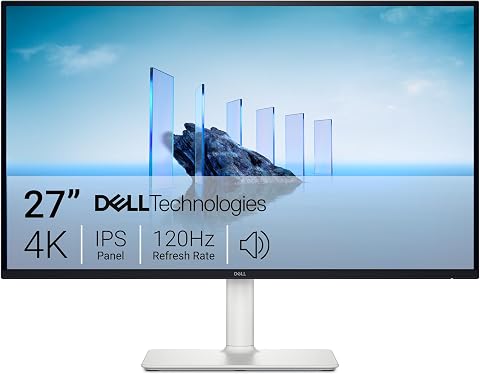
This 27-inch 4K UHD IPS monitor delivers 3840 × 2160 resolution, up to a 120Hz refresh rate, and 99% sRGB color coverage. It includes AMD FreeSync Premium, ComfortView Plus blue-light reduction, built-in speakers, and an adjustable stand with tilt, swivel, height, and pivot adjustments.
Pros:
- 4K UHD resolution with 99% sRGB color coverage
- Up to 120Hz refresh rate with AMD FreeSync Premium
- Height-adjustable stand with swivel, pivot, and tilt
- ComfortView Plus reduces blue-light emissions while maintaining color accuracy
Cons:
- The listing gives conflicting response-time figures: 0.03 milliseconds and 5 milliseconds
- The included connectivity is listed as DisplayPort and HDMI, with no USB-C port specified
Best for: Someone who has confirmed this monitor fits their energy-data setup
Not ideal for: Anyone seeking a standalone household electricity monitor without verifying its function
Bottom line: The listed name identifies a computer monitor, so confirm how it would provide the energy-monitoring function you need.
Portable Power Stations
A portable power station’s stated capacity and output are central to determining whether it suits your intended use. The listed pick is the Jackery HomePower 3600 Plus Portable Power Station, 3584Wh, 3600W. Treat those figures as starting points for comparison and check the product documentation for the conditions and limits that apply to them.
A common mistake is assuming that capacity alone determines which devices a power station can run or for how long. List the equipment you expect to connect, check its power needs, and compare them with the station’s documented output limits and supported connections. Confirm how the manufacturer defines capacity, whether output differs across ports, and what charging methods and conditions are supported. Consider where you will keep and use the unit: verify its dimensions, weight, ventilation guidance, and any placement restrictions in the manual. Do not infer that a portable power station can serve as a permanent home backup or connect to household circuits without specific manufacturer instructions and appropriate installation. If your planned use involves essential equipment, confirm its requirements carefully and ensure the complete setup is supported.
What to look for:
- Documented capacity and conditions for the stated 3584Wh figure
- Output limits and supported connections for each intended device
- Charging methods and requirements described by the manufacturer
- Unit dimensions, weight, ventilation, and placement guidance
- Whether the planned use and any home connection are explicitly supported
Jackery HomePower 3600 Plus Portable Power Station, 3584Wh, 3600W

The Jackery HomePower 3600 Plus is a 3584Wh portable power station with 3600W output, expandable capacity, and 120V and 240V operation when units are connected in parallel. It supports AC, solar, gas-generator, and hybrid charging, and features a wheeled suitcase-style design with a telescopic handle.
Pros:
- High 3584Wh capacity and 3600W output for home backup use.
- Capacity can be expanded, with parallel operation supporting 240V.
- Offers hybrid, AC, solar, and gas-generator charging options.
- Wheels and a telescopic handle make it easier to move.
Cons:
- Weighs 77.2 pounds, which may make lifting difficult.
- Solar panel is optional and not included.
Best for: Someone comparing a portable station for devices within its documented limits
Not ideal for: Anyone expecting unverified whole-home or circuit-connected backup
Bottom line: Match your intended devices and setup to Jackery’s documented capacity, output, and connection guidance.
Whole House Surge Protectors
A whole-house surge protector is tied to a home’s electrical system, so product fit and installation details matter. The listed pick is the Siemens BoltShield FSPD140 Level 2 Whole House Surge Protector – 140kA. Confirm the exact model and its electrical specifications before comparing it with your panel and installation plans.
A frequent mistake is assuming that a named surge rating alone establishes compatibility or protection for every home. Check the manufacturer’s documentation for the meaning of the listed 140kA figure, the required electrical configuration, panel compatibility, installation instructions, and any coordination guidance. Confirm whether the device is suitable for your service and panel rather than relying on appearance or a broad category label. Since this product is intended for whole-house installation, have a qualified electrician assess the panel and perform installation if required by the manufacturer or local rules. Verify space and connection requirements in the panel and ask how the device’s status is indicated and maintained. Do not assume the product can be installed in every panel or by a homeowner without checking the instructions and applicable requirements.
What to look for:
- Meaning and test conditions for the stated 140kA rating
- Required service and electrical configuration
- Panel compatibility and available installation space
- Manufacturer installation and status-indicator instructions
- Qualified electrician guidance and applicable local requirements
Siemens BoltShield FSPD140 Level 2 Whole House Surge Protector – 140kA, 120/240V

The Siemens BoltShield FSPD140 provides Level 2 whole‑home surge protection with a 140 kA surge current rating for both external and internal surges. It features a visual red flag indicator and audible alarm to signal when replacement is needed, and its polycarbonate enclosure is rated for Type 4 outdoor use or indoor load center installation.
Pros:
- High surge current rating of 140 kA offers robust protection for the entire home.
- Visual red flag indicator and audible alarm alert users when replacement is required.
- Enclosure rated for Type 4 outdoor use and can also be installed inside a load center.
- Thermally protected MOVs enhance safety and reliability.
Cons:
- Requires external parallel connection, which may need professional installation.
- Limited to North American Type B plug configuration, restricting use in other regions.
Best for: Homeowners whose electrician confirms a suitable panel and installation
Not ideal for: Anyone choosing solely by the stated surge rating
Bottom line: Verify panel fit, electrical requirements, and installation guidance with the manufacturer and a qualified electrician.
Smart Light Switches
Smart dimmer switches need to fit both the wiring and the lights they control. The listed pick is the ELEGRP DPR30 Smart Wi-Fi Dimmer Switch, 10-Pack. Its name identifies a Wi-Fi dimmer and a ten-pack; it does not establish which wiring configurations, bulbs, or smart home systems it supports.
A common mistake is buying multiple switches before confirming that each location is compatible. Check the manual for wiring requirements, including whether a neutral wire is needed, and verify the supported bulb types and dimming behavior. Confirm Wi-Fi requirements, app or account setup, and any platform compatibility relevant to your household. Review the switch dimensions against the electrical boxes and faceplates at every planned location. Because the pack contains ten switches, count the locations and assess each circuit before opening or installing the units. Electrical work can require a qualified professional; follow the manufacturer’s installation instructions and local requirements. Do not assume all fixtures will dim smoothly or that every switch location has the same wiring. Resolve these details for each location before selecting a multi-pack.
What to look for:
- Wiring requirements for each planned switch location
- Supported bulb types and dimming specifications
- Wi-Fi band, app, and account setup requirements
- Compatibility with the smart home platform you use
- Switch dimensions and the number of compatible locations
ELEGRP DPR30 Smart Wi-Fi Dimmer Switch, 10-Pack

Control and dim compatible lights using the ELEGRP Home app, Amazon Alexa, or Google Assistant, with scheduling and scene features. Each switch supports single-pole or 3-way setups, requires a neutral wire and a 2.4 GHz Wi-Fi network, and does not need a hub.
Pros:
- Supports app, voice, scheduling, and scene controls
- Works in single-pole and 3-way setups
- Slim profile leaves more room in the electrical box
- No hub required
Cons:
- Requires a neutral wire
- Supports only 2.4 GHz Wi-Fi
- In a 3-way circuit, the other switch must be a standard switch
Best for: Someone with multiple locations verified for the switch’s requirements
Not ideal for: Anyone who has not checked wiring and bulb compatibility at each location
Bottom line: Confirm wiring, lighting, and Wi-Fi compatibility at every planned location before choosing the ten-pack.
Battery Backup Systems
A battery backup system calls for careful planning around capacity, connections, and the equipment you want to support. The listed pick is the Anker SOLIX E10 Power Dock and Extra Battery System, 12–90 kWh. Verify the exact system configuration and what the stated capacity range represents before comparing it with your needs.
A common buying mistake is treating a broad capacity range as the capacity of every configuration. Check which components are included, how additional batteries change the system, and what the manufacturer specifies for usable capacity, output, charging, and expansion. List the circuits or devices you hope to back up and confirm that the complete system supports their electrical requirements. Ask Anker or a qualified installer about required wiring, transfer equipment, installation location, and any permitting or service-panel considerations. Check whether the Power Dock and extra batteries are included in the particular package you are reviewing. Do not assume that the system can power an entire home, work with an existing solar setup, or provide a particular runtime unless the manufacturer’s specifications and your installation plan support that use. Size the system from confirmed loads and configuration details.
What to look for:
- What configuration and components the stated 12–90 kWh range describes
- Usable capacity and output for the configuration you plan to buy
- Supported circuits, connections, and expansion requirements
- Installation, location, and service-panel requirements
- Qualified installer guidance and applicable permitting needs
Anker SOLIX E10 Power Dock and Extra Battery System, 12–90 kWh

The Anker SOLIX E10 combines a power module, Power Dock, and two B6000 battery modules for whole-home backup, with capacity expandable from 12 kWh to 90 kWh. It provides 7.6 kW continuous output, up to 10 kW turbo output, and solar input up to 9 kW per unit, with automatic switchover in 20 ms or less.
Pros:
- Expandable battery capacity supports up to 90 kWh.
- Provides 200A whole-home coverage with automatic switchover in 20 ms or less.
- Weather-rated components support outdoor use without shelter.
- Can be wall- or floor-mounted.
Cons:
- Power Dock and extra battery may be dispatched separately.
- Professional installation may be needed for whole-home integration.
Best for: Someone prepared to size a backup system around confirmed loads
Not ideal for: Anyone assuming every package provides the full stated range
Bottom line: Confirm the included components, usable capacity, supported loads, and installation plan before selecting a configuration.
For a budget-first approach, begin by listing the needs you want to address, then compare each product’s required accessories, installation, and compatibility before choosing a configuration. Prioritize products whose purpose and fit are confirmed; for the monitor listing, first establish whether it can serve the energy-monitoring role you need.
Take the checklist one section at a time and use manufacturer documentation to resolve open questions. A little care with fit, function, and setup can help you make choices that suit your home and the way you plan to use them.