
Smart thermostats are the most practical entry point into a learning home — devices that watch your routine, adjust themselves, and quietly trim your energy bill without you touching a dial. After comparing the current field, my top pick is the Google Nest Learning Thermostat (4th gen, Silver), because true self-programming plus an included room sensor puts it a tier above everything else. For tighter budgets, the Amazon Smart Thermostat delivers genuine savings for a fraction of the price, while the standard Google Nest Thermostat (in Charcoal or Snow) lands in the middle as a solid schedule-based option. The main tradeoff in this category is simple: real learning costs real money, and cheaper models ask you to program schedules yourself in exchange for a much lower price and, in Amazon’s case, a mandatory C-wire.

Get home appliances delivered free with Prime
- Fast, free delivery on millions of items
- Prime Video, Amazon Music and more included
- Member-only deals all year
Complete the kit


Key Takeaways
- Only the two Nest Learning Thermostat (4th gen) entries actually learn your schedule — the standard Nest and Amazon models rely on manual schedules and presence detection.
- The Nest Temperature Sensor included with both 4th-gen Learning models fixes hot and cold rooms by managing temperature where it matters, not just in the hallway.
- The Amazon Smart Thermostat is by far the cheapest path to smart climate control, but it requires a C-wire and has no microphone — you speak to an Echo, not the thermostat.
- The Charcoal and Snow standard Nest thermostats are functionally identical; your choice comes down to decor and price at checkout.
- Deeper integration matters: Alexa households get the most from the Amazon unit, while Google Home users will find every Nest model fits more naturally.
| Google Nest Learning Thermostat (4th gen) + Nest Temperature Sensor (2nd gen) – Silver |  | Best Overall | Model: 4th generation | Included accessory: Nest Temperature Sensor (2nd gen) | Display: 60% larger than previous gen, dynamic Farsight | VIEW LATEST PRICE | See Our Full Breakdown |
| Amazon Smart Thermostat, Compatible with Alexa and Ring |  | Best Value | Dimensions: 3.56 x 3.56 x 0.84 in | Weight: 3.86 oz | Model number: S6ED3R | VIEW LATEST PRICE | See Our Full Breakdown |
| Google Nest Thermostat – Smart Thermostat for Home – Programmable Wi-Fi – Charcoal | 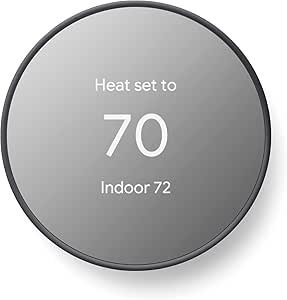 | Best Mid-Range Nest for Google Homes | VIEW LATEST PRICE | See Our Full Breakdown |
| smart home learning device | Compatibility | Connectivity |
|---|---|---|
| Google Nest Learning Thermosta | Most 24V systems; Alexa, Siri, Google Assistant, Matter | Wi-Fi, Google Home app control |
| Amazon Smart Thermostat | Most 24V HVAC systems; C-wire required | 2.4 GHz, 802.11 b/g/n Wi-Fi |
| Google Nest Thermostat | — | — |
More Details on Our Top Picks
Google Nest Learning Thermostat (4th gen) + Nest Temperature Sensor (2nd gen) – Silver
This is the model the rest of the lineup is measured against. Unlike the standard Nest Thermostat, which asks you to build a schedule yourself, the 4th-gen Learning Thermostat genuinely programs itself — it observes when you leave, when you sleep, and how you like your mornings, then writes its own routine. That difference is the entire premium you’re paying for, and it’s why this earns the top spot rather than an honorable mention.
The included Nest Temperature Sensor (2nd gen) is not a throwaway accessory. Most thermostats only know the temperature in the hallway where they hang; with the sensor placed in a bedroom or nursery, this model heats and cools based on the room you actually care about. Neither the Charcoal, Snow, nor Amazon options include this capability out of the box, and it quietly solves one of the most common complaints in home climate control — rooms that never match the thermostat reading.
The 60% larger display with dynamic Farsight is a meaningful upgrade over the puck-style standard Nest, readable across a room rather than up close. Compatibility is broad too, spanning Alexa, Siri, Google Assistant, and Matter. Compared with the Polished Gold version below, the Silver model is functionally identical — same hardware, same sensor — so I’d treat finish preference and street price as the deciding factors. The tradeoffs are real: full functionality depends on Wi-Fi, setup can intimidate first-timers, and this is the most expensive way into the category.
Pros:- Truly learns your schedule instead of requiring manual programming
- Included room sensor enables temperature control based on a specific room
- Large Farsight display readable from across the room
- Works with Alexa, Siri, Google Assistant, and Matter
Cons:- Highest price in the lineup
- Wi-Fi dependency for full feature set
- Setup can be complex for smart-home newcomers
Best for: Homeowners who want genuine set-and-forget learning and whole-home comfort, especially those with uneven room temperatures
Not ideal for: Renters, budget-focused buyers, or anyone content to program a simple schedule themselves
- Model:4th generation
- Included accessory:Nest Temperature Sensor (2nd gen)
- Display:60% larger than previous gen, dynamic Farsight
- Compatibility:Most 24V systems; Alexa, Siri, Google Assistant, Matter
- Connectivity:Wi-Fi, Google Home app control
- Finish:Silver
- Smart features:Learning schedule, adaptive eco mode, energy notifications
- Energy savings:Google cites meaningful reductions in heating and cooling bills
Our verdict“The most complete learning thermostat here — worth the premium if autonomous comfort and room-level control matter to you.”
Amazon Smart Thermostat, Compatible with Alexa and Ring
If the Learning Thermostat is the ceiling, this is the floor — and the floor is surprisingly comfortable. The Amazon Smart Thermostat costs a fraction of what any Nest Learning model does, yet still delivers ENERGY STAR certified savings, presence-based adjustments, and app control from anywhere. You give up self-learning: schedules here are ones you build yourself through the Alexa app, the same tradeoff the standard Nest Thermostat asks for at a noticeably higher price.
Where this model pulls ahead of both standard Nest options is Alexa and Ring integration. In an Echo-heavy household, routines tie together naturally — “Alexa, goodnight” can dial back the heat alongside lights and locks. Guided installation through the Alexa app is among the easiest setup experiences in the category, though the hardware requirement is stricter than Nest’s: a C-wire is mandatory, and homes without one need an adapter or an electrician, which erodes the price advantage.
Two limitations shape the experience. It connects only to 2.4 GHz Wi-Fi, which is fine for most routers but a nuisance on mesh networks that force band steering. And there’s no far-field microphone on the device itself — voice control happens through a separate Echo or the app, unlike the always-ready feel of a Nest on the wall. For the price, though, these are compromises I’d happily make in a secondary home, a rental unit, or a first smart-home project.
Pros:- Lowest cost in the lineup with ENERGY STAR certified savings
- Deep Alexa and Ring integration with app and voice control
- Guided DIY installation through the Alexa app
- Customizable schedules and automatic away adjustments
Cons:- C-wire required, or a separate power adapter
- 2.4 GHz Wi-Fi only
- No built-in microphone — voice control needs a separate Echo device
Best for: Alexa households on a budget who already have a C-wire and don’t need self-learning
Not ideal for: Homes without a C-wire, Google Home-centric users, or buyers who want true autonomous scheduling
- Dimensions:3.56 x 3.56 x 0.84 in
- Weight:3.86 oz
- Model number:S6ED3R
- Compatibility:Most 24V HVAC systems; C-wire required
- Connectivity:2.4 GHz, 802.11 b/g/n Wi-Fi
- Ecosystem:Alexa, Ring
- Certifications:ENERGY STAR, ECOLOGO Gold
Our verdict“The smartest spend-per-dollar option here, provided your wiring and ecosystem already match its requirements.”
Google Nest Thermostat – Smart Thermostat for Home – Programmable Wi-Fi – Charcoal
The standard Nest Thermostat in Charcoal sits in an awkward but defensible middle ground: it’s a real Nest with Google Home integration and HVAC monitoring, at a price well below the Learning models. What you’re buying is a programmable thermostat, not a learning one — you set the schedule in the Google Home app, and the device handles remote adjustments, away detection, and maintenance alerts from there.
Compared with the Amazon Smart Thermostat, this model wins on two fronts: it typically works without a C-wire in most homes, removing the biggest installation hurdle Amazon imposes, and its polished mirror display looks like decor rather than gadgetry. Amazon’s unit counters with a lower price and stronger Alexa integration, so the choice between them mostly mirrors which voice assistant already runs your house.
Against its own sibling — the Snow version — there’s no functional difference whatsoever. I list the Charcoal separately because finish genuinely affects buying decisions: the dark face disappears into dark walls and complements modern interiors, where Snow pops against them. Both share the same gaps: no lock feature to prevent kids or guests from changing settings, full dependence on Wi-Fi for remote features, and occasional need for extra accessories with unusual HVAC setups. It’s the pick I’d suggest for Google Home users who want the Nest experience without the Learning price tag.
Best for: Google Home users who want Nest quality and design at a mid-range price and don’t mind programming schedules themselves
Not ideal for: Alexa-first households, or buyers who expect the thermostat to build its own schedule

How We Picked
Since every product here is an ENERGY STAR certified thermostat, I focused on what actually separates them: how they learn, what they cost to live with, and how well they play with your existing ecosystem. I weighed true autonomous learning against manual scheduling, since that’s the biggest functional divide in this lineup. I also compared installation requirements — the C-wire question alone disqualifies the Amazon model for some homes — and whether bundled extras like room sensors justify a higher price. Finally, I factored in ecosystem lock-in: a thermostat is a long-term purchase, and picking one that fights your voice assistant of choice gets old fast.
| smart home learning device | Compatibility |
|---|---|
| Google Nest Learning Thermosta | Most 24V systems; Alexa, Siri, Google Assistant, Matter |
| Amazon Smart Thermostat | Most 24V HVAC systems; C-wire required |
| Google Nest Thermostat | — |
Factors to Consider When Choosing Smart Home Learning Devices
Beyond the specific models above, a few category-wide questions determine which smart learning thermostat belongs on your wall.Learning versus scheduling
True learning thermostats — the 4th-gen Nest Learning models — observe your habits for about a week and then write their own schedules. Programmable models like the standard Nest and Amazon unit require you to set schedules manually, though they still handle away adjustments automatically. If you’d rather never think about your thermostat again, pay for learning; if you enjoy fine control, a programmable model may actually suit you better.
Wiring and the C-wire question
The Amazon Smart Thermostat requires a C-wire for continuous power; without one, you’ll need an adapter or professional help. Both Nest models are more forgiving, typically working without a C-wire in most homes. Check your existing thermostat’s wiring before buying anything — it’s the single most common return reason in this category.
Ecosystem fit
A thermostat lives in your home for years, so pick the one that matches your voice assistant. Alexa and Ring users get the most from Amazon’s model; Google Home users will find every Nest integrates more naturally, and the 4th-gen Learning models add Siri and Matter support for maximum flexibility.
Room sensors and comfort
A thermostat only measures temperature where it hangs. The included Nest Temperature Sensor with both 4th-gen Learning models lets the system prioritize a specific room — a nursery, bedroom, or home office — which fixes the common problem of rooms that never feel right. If your home has hot and cold spots, this feature alone can justify the upgrade.
HVAC compatibility
All five models work with most 24V systems including gas, electric, forced air, and heat pumps. The standard Nest supports zone control and heat pump systems as well. Unusual setups — high-voltage baseboard heat, proprietary systems — may need adapters or may not work at all, so verify compatibility with the manufacturer’s checker before ordering.
Frequently Asked Questions
Do I really need a learning thermostat, or is a programmable one enough?
It depends on how predictable your routine is. If you leave and return at consistent times, a programmable model like the standard Nest or Amazon Smart Thermostat captures nearly all the savings at a lower price, because your manually set schedule closely matches what a learning algorithm would discover anyway. But if your schedule varies day to day, or you simply never get around to programming a schedule in the first place, the 4th-gen Nest Learning Thermostat pays for its premium by adapting continuously — it notices patterns you wouldn’t bother encoding, like weekend wake times or evening temperature preferences, and corrects itself when your habits change.
What is a C-wire, and why does it matter for the Amazon Smart Thermostat?
The C-wire, or common wire, provides continuous electrical power from your HVAC system to the thermostat, which Wi-Fi devices need to stay connected without draining their batteries. Many older homes don’t have one, and the Amazon Smart Thermostat won’t function reliably without it — you’d need the separately sold power adapter or an electrician, which adds cost. The Nest models are designed to work without a C-wire in most homes by power-cycling off the HVAC wiring, though even they perform better with one. Before buying any smart thermostat, pop the cover off your current unit and check whether a wire is attached to the C terminal.
How much can a smart thermostat actually save on energy bills?
Google cites up to roughly 31% savings on heating and cooling bills for the 4th-gen Learning Thermostat, and ENERGY STAR certification across all five models backs the general claim that smart climate control trims waste. Your real savings depend on your starting point: if you currently leave the heat at one temperature all day, automatic away-mode and learned schedules can meaningfully cut usage. If you’re already diligent about adjusting manually, the savings will be smaller — you’re mostly buying convenience, remote control, and maintenance alerts rather than dramatic bill reductions.
Are the Charcoal and Snow Google Nest Thermostats different products?
No — they’re identical in every functional respect, sharing the same hardware, app experience, ENERGY STAR certification, and feature set. The only difference is the finish: Charcoal has a dark face with a mirror display that blends into darker walls, while Snow is bright and suits lighter interiors. Choose based on your decor and whichever happens to be cheaper at checkout. If you find a meaningful price gap between them, that’s the decision made for you.
What does the included Nest Temperature Sensor actually do?
The sensor is a small battery-powered puck you place in any room — say a bedroom that runs cold or a sun-baked office — and the thermostat then uses that room’s reading to decide when to heat or cool, rather than relying only on the temperature in the hallway where it’s mounted. In practice this means the system targets comfort where you actually sit and sleep, evening out hot and cold spots. Neither the standard Nest nor the Amazon Smart Thermostat includes this out of the box, and adding sensors separately costs extra, so the bundled sensor is a real part of the 4th-gen Learning models’ value proposition.
Conclusion
Matching the right model to the right buyer comes down to three questions: your budget, your voice assistant, and whether you want the thermostat to think for itself. Homeowners who want the full learning experience should buy the Nest Learning Thermostat 4th gen in Silver or Polished Gold — the Silver version is my default pick, with the Gold reserved for design-forward interiors where the finish justifies itself. Budget-conscious Alexa households with a C-wire in place get outstanding value from the Amazon Smart Thermostat. Google Home users who don’t need self-programming should split by decor between the Charcoal and Snow standard Nest, which deliver the core smart experience at a mid-range price. Whichever route you take, verify your wiring first — it’s the one detail that can turn any of these picks into a return shipment.
Fall yard work Picks
leaf blowers
As an affiliate, we earn on qualifying purchases.