
TL;DR

Get home appliances delivered free with Prime
- Fast, free delivery on millions of items
- Prime Video, Amazon Music and more included
- Member-only deals all year
A Hunker home-improvement report describes using a curtain rod and S-shaped hooks to move utensils, mugs and other items off kitchen counters. The setup can add accessible storage, but the rod’s load limit, mounting method and placement matter; the report gives a typical capacity range of 20 to 50 pounds.
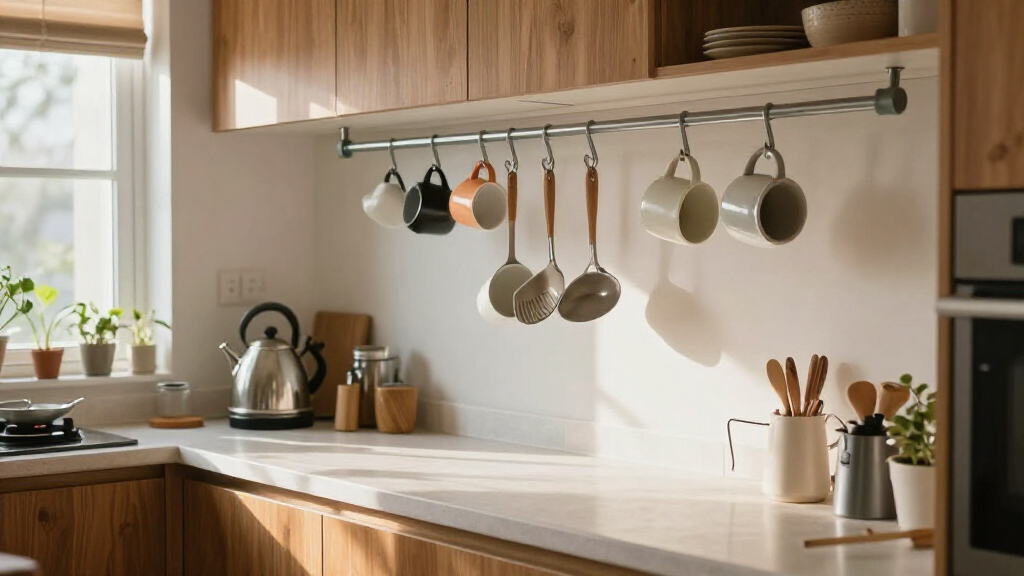
Hunker has reported that a curtain rod fitted with S-shaped hooks can serve as wall storage for kitchen utensils and other items, moving them off counters and freeing space for food preparation. The household tip is aimed in particular at kitchens with limited work surfaces, though safe placement and the rod’s weight capacity constrain what can be hung.
The method uses a rod installed in an open stretch of wall, such as between or beneath cabinets or along a backsplash, with movable hooks attached for hanging utensils. Hunker also suggests using the hooks for mugs, measuring cups and cutting boards, and says a small basket supported by two hooks can hold items such as spice jars.
The report gives a typical curtain-rod capacity of 20 to 50 pounds, while noting that users should not overload the setup. Actual capacity depends on the particular rod, its brackets or other mounting hardware, the wall or cabinet surface, and installation. The source does not provide tested load ratings for specific products or mounting configurations.
For installation, Hunker recommends measuring the available space and choosing a rod that fits both the area and the items to be stored. Traditional rods generally use screws for more secure support, the report says; a tension rod between cabinets is presented as an alternative for renters. The hooks can be shifted along the rod as storage needs change.
More Work Surface in Small Kitchens
Moving frequently used tools off the counter can make a compact kitchen easier to use for meal preparation and everyday organization. The approach makes use of vertical space that may otherwise sit empty, rather than requiring a separate countertop organizer that occupies more of the work surface.
It is a modest storage option, not a substitute for adequate cabinets or a guarantee of more usable space in every kitchen. Hanging items remain visible and may be harder to keep clean near cooking areas. The practical benefit depends on having a suitable wall or cabinet location, selecting appropriate hardware and keeping the load within the installed system’s limits.
Products Worth Considering

eufy Security Essential 7-Piece Alarm System

Ring Alarm 14-Piece Wireless Security System

Philips Hue Secure Wired Video Doorbell, 2K Resolution, Wide Angle View, Integrated Hue Lights, Two-Way Audio, Infrared Night Visibility, Bl
As an affiliate, we earn on qualifying purchases.
Choosing a Safe Rod Location
The source frames the idea as a simple DIY storage change that can be adjusted to a kitchen’s layout and style. It recommends checking the available wall space first, measuring for the rod, and considering the finish and color alongside the kitchen’s existing decor. Hunker also notes that hanging utensils puts them on display, which may influence which items a household chooses to store there.
Placement is also a safety issue. Hunker advises against installing the rod above the stove, citing grease and fire concerns, particularly for wooden or plastic utensils. Items should be positioned at a reachable height, and the mounting approach should suit the surface and expected load. A tension rod may be convenient between cabinets, but the source does not establish that every tension rod is suitable for heavy or frequent use.
““Ample counter space is a luxury in any kitchen.””
— Hunker report
Capacity Depends on the Installation
The source does not identify the tested products behind its 20-to-50-pound range, explain how that capacity was measured, or specify how much weight a particular wall, bracket or tension rod can safely support. Readers should consult the product’s instructions and mounting requirements rather than treating the general range as a guaranteed limit.
It is also unclear how the setup performs over time in kitchens exposed to moisture, heat or repeated movement of hanging items. The report does not include comparative testing, cost estimates for a complete installation, or evidence that the arrangement suits every rental agreement or cabinet configuration.
Measure, Mount and Check the Load
Anyone considering the setup should first identify a location away from the stove, confirm that hanging items will be reachable, and measure the space. The next step is to choose a rod and hooks suited to the planned load, then follow the manufacturer’s guidance for the surface and mounting hardware. After installation, users should distribute items carefully and check that the rod and supports remain secure.
Hunker presents the arrangement as a household tip rather than a tested product recommendation. The source material does not describe a formal evaluation or a follow-up development; whether the storage proves useful will depend on the kitchen layout, the items hung and the strength of the installation.
Key Questions
What can be hung from a curtain rod in a kitchen?
Hunker suggests utensils, mugs, cutting boards and measuring cups. It also describes hanging a small basket from two hooks for items such as spice jars. The rod and supports must be appropriate for the combined weight.
How much weight can a curtain rod hold?
The report gives a typical range of 20 to 50 pounds, but that is not a rating for every product or installation. Check the manufacturer’s load limit and mounting instructions for the specific rod and surface.
Where should the rod be installed?
Possible locations include open space between or under cabinets or along a backsplash, provided items are easy to reach. Hunker advises against placement above the stove because of grease and fire concerns.
Can renters use this storage idea?
The report suggests a tension rod between cabinets as a renter-friendly option. Its suitability depends on the cabinet spacing, the rod’s instructions and the weight being hung; check rental rules before making changes that require screws.
Source: hunker.com