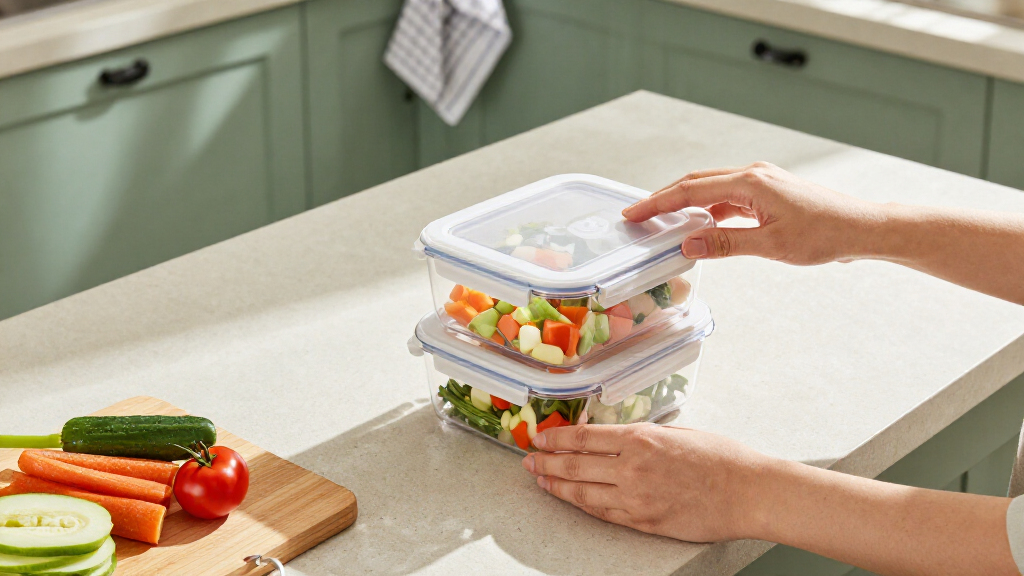
“Automatic food storage containers” can mean two different things: containers that use a pump to remove air, or conventional containers with lids that seal shut. The real choice is whether extra freshness control justifies added equipment, steps and cost. Vacuum-sealing containers can help with foods that lose quality quickly or sit in storage for longer; standard airtight containers are simpler for leftovers, lunches and pantry staples used soon. Neither type makes food safe indefinitely, so storage time and temperature still matter.

Get home appliances delivered free with Prime
- Fast, free delivery on millions of items
- Prime Video, Amazon Music and more included
- Member-only deals all year

Frienhund Automatic Pet Feeder with 2K Camera, 7L Storage, and Night Vision
- ✔ Brand: Frienhund
- ✔ Target species: Cats, large dogs, and small animals
- ✔ Food capacity: 7 L (29 cups)

Wall-Mounted Rice and Dry Food Dispenser
- ✔ Brand: RCJCQSR
- ✔ Material: PP
- ✔ Dimensions: 36.6 × 32.4 × 38 cm

VEVOR Rice and Pet Food Storage Containers, 2-Pack, 20 L Each
- ✔ Brand: VEVOR
- ✔ Quantity: Two containers
- ✔ Capacity: 20 L (4.5 gal) each
This comparison focuses on vacuum-sealing containers (A) and standard airtight containers (B), rather than smart containers that monitor food or dispense it automatically. For most everyday kitchens, standard airtight containers are the better starting point. Choose vacuum-sealing when longer storage and reduced air exposure matter enough to justify the extra process.
At a Glance
| Criteria | Vacuum-sealing food storage containers | Standard airtight food storage containers | Winner |
|---|---|---|---|
| Freshness over time | Can reduce air exposure and slow quality loss for suitable foods; results vary by food and seal quality. | Limits air exchange, but does not remove the air already inside; well suited to routine short-term storage. | A |
| Everyday convenience | Requires a pump or sealing step; some systems are quicker than others. | Close the lid and store; quick to open, refill and reuse. | B |
| Upfront and ongoing cost | Usually costs more and may require a compatible pump or replacement parts. | Usually lower cost, with wide choice of sizes and replacement options. | B |
| Food compatibility | Useful for many dry, firm or portioned foods; delicate, crushable or liquid foods can be awkward. | Works for most leftovers, produce, pantry goods and packed meals, subject to container material and food needs. | B |
| Storage flexibility | Often depends on system-specific lids or containers; not all pieces interchange. | Many shapes and sizes are available; some brands offer compatible modular pieces. | B |
| Cleaning and upkeep | More parts and seals can mean extra cleaning and occasional seal maintenance. | Lids and containers are generally straightforward to wash, though care varies by material. | B |
Frienhund Automatic Pet Feeder with 2K Camera, 7L Storage, and Night Vision
For buyers who mean true automation, Frienhund is the clearest match in this lineup. It can schedule as many as 15 meals per day, with up to 20 portions per meal, and its app supports remote schedule changes and feeding history. That makes it more useful for managing a pet’s routine than either the wall dispenser or VEVOR bins, neither of which offers timed feeding.The 3-megapixel camera with infrared night vision, motion alerts, and two-way audio add remote oversight. These features may help us check whether a pet is near the feeder, but they do not replace being at home or confirm that a particular animal ate every portion. The 7 L tank is also substantially more suited to holding a reserve of pet food than the wall unit’s small-food compartments, and the transparent tank helps us see when a refill is due.Cleaning and backup are the main practical considerations. The removable food tank and dishwasher-safe stainless steel bowl simplify routine upkeep, while battery backup can help the feeder keep operating during an outage. That backup requires three D-cell batteries, however, and TF card storage is limited to 128 GB, with cloud storage also listed. Compared with VEVOR, this is the better choice for controlled pet portions, but it is more dependent on an app-connected setup and is not a general pantry dispenser.
Pros:
- Schedules up to 15 meals per day and supports remote schedule changes.
- Camera offers infrared night vision, motion alerts, and two-way audio.
- Removable tank and dishwasher-safe stainless steel bowl support easier cleaning.
- Battery backup can keep feeding operational during a power outage.
Cons:
- Battery backup requires three D-cell batteries.
- TF card storage supports up to 128 GB.
- Designed around pet feeding rather than dispensing a variety of pantry staples.
Best for: Pet owners who want to schedule meals, adjust feeding remotely, and check the feeding area through a camera.
Not ideal for: Households looking for a simple pantry container, or buyers who do not want app connectivity, camera features, or separate backup batteries.
Bottom line: Choose Frienhund when scheduled pet portions and remote monitoring matter more than keeping a simple bulk-food container.
“Choose Frienhund when scheduled pet portions and remote monitoring matter more than keeping a simple bulk-food container.”
Wall-Mounted Rice and Dry Food Dispenser
This wall-mounted dispenser is the most convenient fit for a pantry where we use several small dry staples often. Its six compartments and adjustable dividers let us dedicate space to different grains or beans, while the transparent body makes it easier to see what remains. Pressing the dispenser provides access without lifting a large bin or opening a bag each time.It occupies a different niche from the Frienhund: there is no app, meal timer, or remote monitoring, but the wall unit provides quick manual access to foods such as rice, millet, barley, mung beans, and red beans. Compared with VEVOR’s sealed bulk bins, it prioritizes organized, visible selection over storing large reserves. A removable top cover makes refilling more direct, though buyers should plan for a fixed wall location and ensure the mounting arrangement suits their kitchen.Food size is the key limitation. The description specifically rules out larger foods such as cashews and soybeans, so a mixed pantry may require another container. The compartments also make this less suited to keeping a single large quantity of one ingredient. Choose it for repeated access to small dry foods; choose VEVOR if capacity and sealed storage matter more, or Frienhund if you need scheduled pet meals.
Pros:
- Six compartments keep multiple small dry foods separated.
- Adjustable dividers allow different compartment sizes.
- Transparent body makes it easy to check contents.
- Removable top cover supports refilling.
Cons:
- Not suitable for larger foods such as cashews or soybeans.
- Wall mounting requires a suitable location and setup.
- Manual measurements may vary by 1–3 cm.
Best for: Pantry organizers who regularly use several small grains or beans and want visible, press-to-dispense access.
Not ideal for: Buyers storing large beans, nuts, bulky items, or one large reserve of food, and anyone needing timed or remote dispensing.
Bottom line: Pick the wall dispenser for quick access to several small pantry staples when its food-size limits fit your routine.
“Pick the wall dispenser for quick access to several small pantry staples when its food-size limits fit your routine.”
VEVOR Rice and Pet Food Storage Containers, 2-Pack, 20 L Each
When the priority is keeping two sizable supplies organized, the VEVOR set offers the most stated combined capacity: two containers at 20 L each. They can be assigned to different dry goods such as rice, grains, flour, or pet food. Transparent windows let us check levels, and the wide openings make filling and scooping more practical than working through the narrower compartments of the wall dispenser.Locking latches, a double sealing ring, and a lid desiccant box are intended to help protect contents from moisture. Those details make this set more storage-focused than the Frienhund, which is built around controlled pet portions and monitoring. The included measuring cup provides a simple way to transfer food, but the bins do not schedule or automatically release servings. If the main goal is hands-off pet feeding, Frienhund remains the more relevant pick.Capacity brings a space tradeoff: each bin measures about 14.37 × 9.05 × 17.44 inches, so two can be cumbersome in a compact kitchen or cupboard. The product details also do not list desiccant packs among the included components, despite describing a lid desiccant box. We should confirm what is supplied and plan for desiccant separately if needed. Compared with the wall dispenser, VEVOR suits larger quantities and broader listed food types, but offers less compartmentalized, at-a-glance selection.
Pros:
- Two 20 L containers provide substantial combined storage.
- Locking latches and a double sealing ring are designed to help keep contents dry.
- Transparent windows make remaining food easier to check.
- Wide openings, stackable design, and included measuring cup support practical storage.
Cons:
- Each 20 L container may be bulky for limited storage areas.
- Desiccant packs are not listed among the included components.
- Storage-focused design does not automatically portion or schedule servings.
Best for: Households that store larger amounts of dry staples or pet food and have room for two substantial bins.
Not ideal for: Small kitchens, buyers who need timed dispensing, or anyone who specifically wants separate easy-access compartments for many small ingredients.
Bottom line: Choose VEVOR when bulk capacity and moisture-conscious storage matter more than automatic dispensing or compact access.
“Choose VEVOR when bulk capacity and moisture-conscious storage matter more than automatic dispensing or compact access.”
As an Amazon Associate we earn from qualifying purchases.
Key Differences
The main performance difference is what happens to the air inside the container. A vacuum system removes much of it, which can help limit oxidation and preserve quality in appropriate foods. A regular airtight lid slows new air from entering but leaves the original air in place. That gives A an advantage for foods where air exposure is the problem, but it is not a universal freshness guarantee: food type, temperature, moisture and seal quality all affect results.
That preservation step comes with practical costs. Vacuum systems need compatible equipment and an extra action each time food is stored. Standard containers close quickly, stack in many configurations and suit a wider range of ordinary meals. For a household that mainly stores leftovers for the next few days, B is usually better value. A earns its higher cost when the same foods are repeatedly stored longer, portioned ahead or protected from freezer quality loss.
Compatibility and upkeep also shape the decision. Vacuum containers can be less flexible if lids or valves only work with one system, while conventional containers are broadly available in different shapes and sizes. Both need sound seals and proper washing. Compare the actual container materials, dishwasher guidance and replacement-part availability before buying.
Detailed Comparison
Freshness over time (Vacuum-sealing food storage containers wins — moderate)
A wins by a moderate margin for suitable foods stored longer: removing much of the air can slow some quality changes. B reduces air exchange but retains air in the container, so it is better suited to routine storage where food will be used soon. Neither method replaces refrigeration or makes food last indefinitely.
Everyday convenience (Standard airtight food storage containers wins — moderate)
B wins by a moderate margin for frequent daily use. Its routine is simply fill, close and store. A adds a pumping or sealing step and can take more time when storing several items. If a particular vacuum system is quick and remains on the counter, the gap may feel smaller, but the extra step remains.
Upfront and ongoing cost (Standard airtight food storage containers wins — major)
B wins by a major margin for budget-conscious buyers. Standard containers are available at many price points and do not inherently require a pump. A costs more because of the sealing mechanism and system-specific parts; replacement seals or lids may add expense. Pay more for A when its preservation benefit will be used regularly, rather than for a feature that will sit idle.
Food compatibility (Standard airtight food storage containers wins — moderate)
B wins by a moderate margin for mixed household use. Its straightforward design accommodates most leftovers and meal-prep portions. A can suit firm foods and dry goods, but delicate items may be crushed by suction and liquids can complicate sealing. Check the manufacturer’s directions for specific foods and avoid assuming every container is suitable for every use.
Storage flexibility (Standard airtight food storage containers wins — moderate)
B wins by a moderate margin. Conventional containers come in many shapes and sizes, and replacements are often easier to find. A may tie you to a particular lid, valve or pump system. Before choosing A, check whether the set includes sizes you will use and whether compatible pieces are sold separately.
Cleaning and upkeep (Standard airtight food storage containers wins — minor)
B wins by a minor margin. Both types require clean containers and intact seals, but vacuum models may add valves, gaskets or pump components that need attention. A has little practical disadvantage if those pieces are easy to remove and wash. Follow care instructions, since dishwasher suitability differs across products.
Vacuum-sealing food storage containers: Pros and Cons
Pros:
- Removes much of the air around suitable foods.
- Can help preserve quality during longer storage or freezing.
- Useful for portioning foods in advance.
Cons:
- Costs more and may require a compatible pump.
- Adds a sealing step to the storage routine.
- May be less suitable for delicate foods, liquids or incompatible containers.
Standard airtight food storage containers: Pros and Cons
Pros:
- Simple to use for routine storage.
- Usually lower cost and available in many sizes.
- Works across a broad range of everyday foods.
Cons:
- Leaves air inside the container.
- May be less effective at slowing quality loss for foods stored longer.
- Seal quality and lid fit still matter.
Who Should Choose What
Choose Vacuum-sealing food storage containers if:
- You regularly store suitable foods for longer periods and want to reduce air exposure.
- You portion foods ahead or freeze items where freezer quality matters to you.
- You are willing to use and maintain a pump system for that benefit.
Choose Standard airtight food storage containers if:
- You mainly store leftovers, lunches and pantry items for near-term use.
- You want low-cost containers that are quick to open, wash and reuse.
- You need varied sizes and broad compatibility for everyday meals.
Skip both if: You need storage that automatically tracks food safety or guarantees a specific shelf life; these containers do not replace temperature control, food-safety guidance or a dedicated monitoring system.
Value for Money
For most kitchens, standard airtight containers offer better value because they cover routine storage at lower cost and with less effort. Paying more for vacuum-sealing containers makes sense when you will use the pump often and the foods you store benefit from less air exposure. If you only occasionally keep leftovers, the added cost and steps are unlikely to pay off. Compare total system cost, including the pump, compatible lids and replacement seals, rather than the container price alone.
Final Verdict
Choose standard airtight containers if you want dependable, convenient storage for everyday leftovers, lunches and pantry goods; they are the clear recommendation for most households. Choose vacuum-sealing containers if longer storage is a frequent need and you will consistently use the pump for foods suited to that method. The deciding factor is how often reduced air exposure will improve the storage you actually do. If that use is occasional, keep the simpler containers and save the premium.
Frequently Asked Questions
Do vacuum-sealing containers keep food fresh longer?
They can help preserve quality for some foods by removing much of the air, but outcomes depend on the food, storage conditions and seal. They do not guarantee a particular shelf life or replace refrigeration and safe handling.
Are vacuum containers worth the extra cost?
They can be worth it if you regularly store suitable foods for longer periods or freeze portions and will use the system often. For routine leftovers used soon, standard airtight containers are usually better value.
Can I store liquids in vacuum-sealing containers?
It depends on the system and its instructions. Liquids can interfere with sealing or be drawn toward the valve, so check the manufacturer’s guidance before using one for soups or sauces.
Which type is easier to use every day?
Standard airtight containers are generally easier: fill, close and store. Vacuum models add a pumping or sealing step, which is worthwhile only when the additional air removal matters to you.