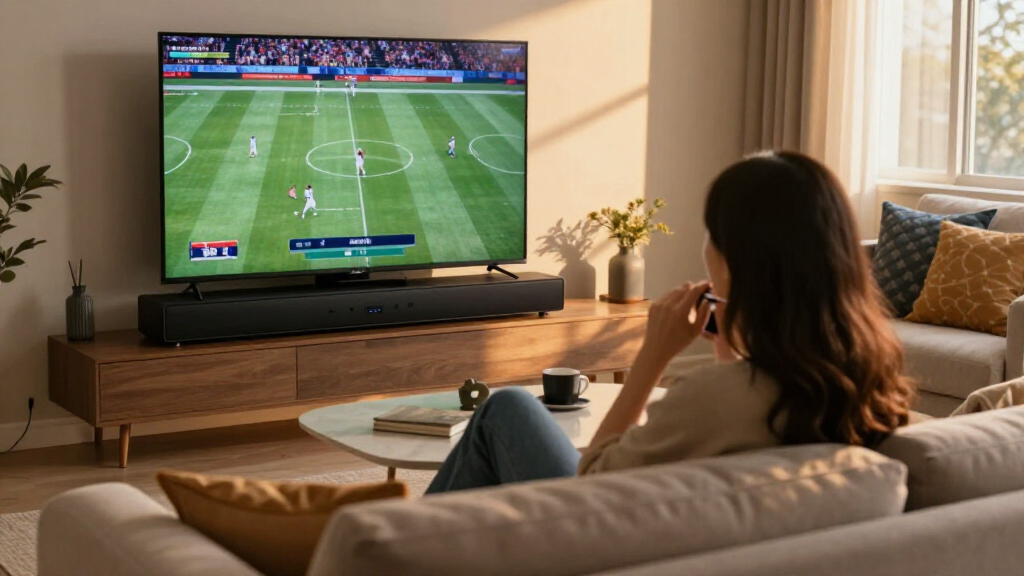

Watching NFL games is as much about sound as picture — play-by-play commentary, quarterback audibles, and stadium atmosphere all depend on a soundbar that can keep dialogue crisp while handling crowd roar without turning muddy. After comparing 15 smart soundbars across dialogue clarity, immersion, room fit, and price, the Samsung Q800F stands out as the best overall pick for football Sundays, pairing a 5.1.2 channel setup with a wireless subwoofer that makes every hit feel physical. The Sonos Arc Ultra is the stronger choice for whole-room Atmos without rear speakers, while the budget-friendly ULTIMEA Poseidon M60 delivers surprising 5.1 surround for far less money. The main tradeoff in this category is between dialogue-first clarity and full stadium-style immersion — and between plug-and-play simplicity and app-driven customization. Read on for the full breakdown, including who each model is for and who should skip it.

Get home appliances delivered free with Prime
- Fast, free delivery on millions of items
- Prime Video, Amazon Music and more included
- Member-only deals all year
Complete the kit


Key Takeaways
- Dialogue clarity separated the top picks more than raw power: the Samsung Q800F, Bose Smart Ultra, and Sonos Arc Ultra all use AI-driven dialogue processing that keeps play-by-call commentary audible during loud crowd moments, something the budget 2.0 bars struggled with.
- A wireless subwoofer matters more for NFL games than Atmos height channels — the LG S60T and JBL Bar 500MK2 outperformed pricier Atmos-only bars at conveying the impact of tackles and stadium rumble.
- Under $200, the ULTIMEA Poseidon M60 and detachable 2-in-1 soundbar deliver genuine surround value, while the TCL S45H and Sony S100F trade immersion for simplicity and price.
- Ecosystem lock-in is a real cost: Samsung Q-Symphony and LG TV Synergy only unlock their full potential with matching TVs, so cross-brand buyers get less value from those premium features.
- The Bose TV Speaker remains the best pure dialogue bar for older TVs without eARC, but buyers wanting smart features, voice assistants, or future Atmos content should spend more.
| TCL S45H 2.0 Sound Bar for Smart TV with Dolby Atmos and DTS:X |  | Best Budget Atmos Pick | Power Output: 100W | Channels: 2.0 | Audio Formats: Dolby Atmos, DTS:X | VIEW LATEST PRICE | See Our Full Breakdown |
| Sound Bar for Smart TV with Bluetooth, ARC, Optical, AUX – Detachable 2-in-1 Design |  | Best Flexible-Placement Pick | Power Output: 80W | Drivers: 4 high-performance drivers | Design: Detachable 2-in-1 (horizontal or vertical) | VIEW LATEST PRICE | See Our Full Breakdown |
| Samsung S60D 5.0ch Soundbar with Wireless Dolby Atmos and Alexa Built-in |  | Best All-in-One Smart Pick | Channels: 5.0 | Dolby Atmos: Wireless | Subwoofers: Built-in | VIEW LATEST PRICE | See Our Full Breakdown |
| Samsung Q800F 5.1.2ch Q Series Soundbar and Subwoofer |  | Best Premium Stadium Sound | Channels: 5.1.2 | Dolby Atmos: Wireless | Subwoofer: Wireless, included | VIEW LATEST PRICE | See Our Full Breakdown |
| Bose TV Speaker – Compact Soundbar with Bluetooth and HDMI-ARC |  | Best for Commentary Clarity | Dimensions: 23.38″ W x 2.21″ H x 4.02″ D | Connectivity: HDMI-ARC, optical, Bluetooth, AUX | Audio Focus: Dialogue clarity, wide natural sound | VIEW LATEST PRICE | See Our Full Breakdown |
| Sonos Arc Ultra Soundbar with Dolby Atmos – Black |  | Best Premium Splurge | Audio Channels: 9.1.4 | Audio Format: Dolby Atmos, Hi-Res Audio | Connectivity: HDMI eARC, Bluetooth, Wi-Fi | VIEW LATEST PRICE | See Our Full Breakdown |
| JBL Bar 500MK2 5.1 Channel Soundbar System with Dolby Atmos, Wireless Subwoofer, and Voice Assistant Compatibility |  | Best for Stadium-Shaking Bass | Power Output: 750W | Channels: 5.1 | Subwoofer: 10-inch wireless | VIEW LATEST PRICE | See Our Full Breakdown |
| Bose Smart Ultra Dolby Atmos Soundbar, All-in-One Surround Sound System for TV |  | Best All-in-One Smart Pick | Audio Format: Dolby Atmos, TrueSpace | Speaker Configuration: Six full-range transducers, two upward-firing dipoles | Dialogue Tech: A.I. Dialogue Mode | VIEW LATEST PRICE | See Our Full Breakdown |
| Fire TV Soundbar Plus (Newest Model) with Built-in Subwoofer, 3.1 Channel, Dolby Atmos, Clear Dialogue |  | Best Budget Value | Channels: 3.1 | Audio Formats: Dolby Atmos, DTS:X | Subwoofer: Built-in | VIEW LATEST PRICE | See Our Full Breakdown |
| Bose Smart Dolby Atmos Soundbar, All-in-One TV Soundbar with Voice Control and Built-in Alexa |  | Best Compact Smart Bar | Audio Format: Dolby Atmos, TrueSpace | Speaker Configuration: Five transducers, two upward-firing | Dialogue Tech: A.I. Dialogue Mode | VIEW LATEST PRICE | See Our Full Breakdown |
| LG S60T 3.1 Channel Soundbar with Wireless Subwoofer |  | Best for LG TV Owners | Channels: 3.1 | Wireless Subwoofer: Yes | Dolby Audio: Yes | VIEW LATEST PRICE | See Our Full Breakdown |
| Samsung HW-Q800F 5.1.2ch Q Series Soundbar |  | Best Premium Game-Day Experience | Channels: 5.1.2 | Wireless Dolby Atmos: Yes | Subwoofer: 8-inch passive radiator, 6.5-inch active driver | VIEW LATEST PRICE | See Our Full Breakdown |
| Sony S100F 2.0ch Compact Soundbar with Bluetooth |  | Best Budget Starter Bar | Channels: 2.0 | Audio Mode: S-Force Pro front surround | Connectivity: HDMI ARC, Bluetooth (10m range) | VIEW LATEST PRICE | See Our Full Breakdown |
| Sonos Beam Gen 2 – Black – Soundbar with Dolby Atmos |  | Best Smart Ecosystem Pick | Channels: 2 (virtual Atmos) | Dolby Atmos: Yes (virtualized) | Control: App, remote, voice (Alexa/Google) | VIEW LATEST PRICE | See Our Full Breakdown |
| ULTIMEA 5.1CH Surround Sound Bar System, Poseidon M60 |  | Best Value Surround System | Channels: 5.1 with Dolby Atmos | Power Output: 300W | Subwoofer: 5.25-inch wired, wooden enclosure, BassMX | VIEW LATEST PRICE | See Our Full Breakdown |
| smart soundbars for NFL game | Connectivity | Channels |
|---|---|---|
| TCL S45H 2.0 Sound Bar for Sma | HDMI eARC/ARC, optical, Bluetooth, AUX | 2.0 |
| Sound Bar for Smart TV with Bl | Bluetooth 5.0, ARC, optical, AUX | — |
| Samsung S60D 5.0ch Soundbar wi | — | 5.0 |
| Samsung Q800F 5.1.2ch Q Series | — | 5.1.2 |
| Bose TV Speaker | HDMI-ARC, optical, Bluetooth, AUX | — |
| Sonos Arc Ultra Soundbar with | HDMI eARC, Bluetooth, Wi-Fi | — |
| JBL Bar 500MK2 5.1 Channel Sou | HDMI eARC, 4K Dolby Vision passthrough | 5.1 |
| Bose Smart Ultra Dolby Atmos S | HDMI eARC, optical audio, Bluetooth | — |
| Fire TV Soundbar Plus | HDMI eARC/ARC, Bluetooth | 3.1 |
| Bose Smart Dolby Atmos Soundba | Bluetooth, AirPlay 2, Spotify Connect, Chromecast | — |
| LG S60T 3.1 Channel Soundbar w | — | 3.1 |
| Samsung HW-Q800F 5.1.2ch Q Ser | Wireless, Alexa, AirPlay 2, Google Cast | 5.1.2 |
| Sony S100F 2.0ch Compact Sound | HDMI ARC, Bluetooth (10m range) | 2.0 |
| Sonos Beam Gen 2 | HDMI, Wi-Fi, Ethernet, AirPlay 2 | 2 (virtual Atmos) |
| ULTIMEA 5.1CH Surround Sound B | HDMI eARC, Bluetooth 5.4 | 5.1 with Dolby Atmos |
More Details on Our Top Picks
TCL S45H 2.0 Sound Bar for Smart TV with Dolby Atmos and DTS:X
This option stands out for bringing Dolby Atmos and DTS:X to a budget price point, which is rare at 100W and under. For NFL broadcasts, the real payoff is crowd atmosphere and stadium ambience spreading wider than the TV speakers — the AI Sonic room calibration tunes the output to your living room rather than relying on a one-size-fits-all profile. Compared with the Bose TV Speaker, the TCL trades away some dialogue purity but delivers a noticeably bigger, more spatial game-day soundstage. Unlike the detachable 2-in-1 bar, it skips gimmicky placement tricks in favor of straightforward wall-mount or tabletop positioning. The tradeoff: with no subwoofer and only a 2.0 configuration, low-end hits on kickoffs and halftime shows will feel thin against the Samsung Q800F’s dedicated wireless sub. This pick makes the most sense for value hunters in apartments or smaller dens.
Pros:- Dolby Atmos and DTS:X at a budget price for wider game-day sound
- AI auto room calibration balances sound for your specific space
- Full accessory kit including HDMI cable and wall-mount hardware
- Multiple inputs (HDMI eARC, optical, Bluetooth, AUX) simplify hookup
Cons:- No subwoofer, so kickoffs and crowd roars lack low-end punch
- Full feature set requires app-based setup
- Slim 2.0 design underperforms in large rooms
Best for: Budget-minded fans in small-to-medium rooms who want Atmos-style stadium ambience without paying flagship prices
Not ideal for: Bass lovers and owners of large living rooms — the 2.0 layout with no subwoofer can’t fill big spaces or deliver deep hits
- Power Output:100W
- Channels:2.0
- Audio Formats:Dolby Atmos, DTS:X
- Connectivity:HDMI eARC/ARC, optical, Bluetooth, AUX
- Room Calibration:AI Sonic auto calibration
- Dimensions:31.89″ W x 2.36″ H x 3.86″ D
- Included Accessories:HDMI cable, power cord, remote, wall-mount kit
Our verdict“A smart buy for smaller rooms where Atmos width matters more than bass depth and price is the deciding factor.”
Sound Bar for Smart TV with Bluetooth, ARC, Optical, AUX – Detachable 2-in-1 Design
The headline here is the detachable 2-in-1 design — split it into two vertical towers flanking the TV, or run it as a single horizontal bar. That flexibility matters if your media console is an awkward shape or you want a pseudo-surround effect without running wires behind the couch. Four drivers and 80W give it more grunt than the similarly affordable TCL S45H, though it lacks Atmos entirely, so stadium sound stays more two-dimensional. The three EQ modes (movie, music, news) are the practical draw for NFL viewing: movie mode fattens up crowd noise while news mode tightens commentary clarity — a trick the Bose TV Speaker handles automatically but this bar leaves to you. Compared with the Samsung S60D, there’s no smart assistant or calibration, just bare-bones audio flexibility. Setup with detachable sections may frustrate less technical buyers.
Pros:- Detachable design enables vertical tower or horizontal bar placement
- Four drivers deliver fuller sound than typical budget bars
- Three EQ modes let you switch between commentary clarity and crowd energy
- Bluetooth 5.0 plus ARC, optical, and AUX covers every hookup scenario
Cons:- No Dolby Atmos or spatial audio at any price
- Mounting hardware may not be included, adding hidden cost
- Detachable setup adds complexity for non-technical users
Best for: Renters and tinkerers with unconventional room layouts who want placement options without spending much
Not ideal for: Buyers who want set-and-forget simplicity or immersive spatial audio — no Atmos, no auto calibration, and assembly adds friction
- Power Output:80W
- Drivers:4 high-performance drivers
- Design:Detachable 2-in-1 (horizontal or vertical)
- Placement Options:Horizontal, vertical, tabletop, wall mount
- Connectivity:Bluetooth 5.0, ARC, optical, AUX
- Equalizer Modes:Movie, music, news
- Warranty:18 months
Our verdict“Choose this if placement flexibility and price trump having the latest audio formats on game day.”
Samsung S60D 5.0ch Soundbar with Wireless Dolby Atmos and Alexa Built-in
This model earns its slot by packing 5.0 channels, Dolby Atmos, and Alexa into a single bar with no separate sub to position or cable — the built-in subwoofers handle low frequencies internally. That makes it the strongest one-box option here short of the pricier Bose Smart Ultra. Where the Samsung S60D pulls ahead of the TCL S45H is dialogue handling: Adaptive Sound mode automatically lifts play-by-play commentary above crowd roar, which is arguably the single most useful feature for NFL viewing. SpaceFit Sound Pro calibration also outclasses the basic room tuning on cheaper bars. The catch: Q-Symphony — which synchronizes the bar with your TV’s own speakers — only works with compatible Samsung TVs, so half the marketing falls away for everyone else. AirPlay 2 and Chromecast round out a genuinely smart package, but setup can overwhelm non-technical households.
Pros:- Adaptive Sound automatically clarifies play-by-play over crowd noise
- All-in-one design with built-in subwoofers eliminates placement hassle
- Alexa, Chromecast, and AirPlay 2 cover every smart ecosystem
- SpaceFit Sound Pro tailors audio to your room’s acoustics
Cons:- Q-Symphony requires a compatible Samsung TV to function
- Built-in subwoofers can’t match a dedicated wireless sub like the Q800F’s
- Premium feature set carries a premium price
Best for: Viewers who want Atmos, voice control, and auto dialogue enhancement in one box with no subwoofer clutter
Not ideal for: Non-Samsung TV owners who’d be paying for Q-Symphony features they can’t use, and anyone wanting true room-shaking bass
- Channels:5.0
- Dolby Atmos:Wireless
- Subwoofers:Built-in
- Room Calibration:SpaceFit Sound Pro
- Dialogue Enhancement:Adaptive Sound
- Smart Features:Alexa built-in, Chromecast, AirPlay 2
- Gaming:Game Mode Pro
Our verdict“The best single-box upgrade for football fans who hate clutter and want commentary that always cuts through.”
Samsung Q800F 5.1.2ch Q Series Soundbar and Subwoofer
If the goal is making your living room feel like the 50-yard line, this is the pick in this batch. The 5.1.2 configuration with a wireless subwoofer delivers overhead Atmos channels and genuine low-end authority — something no other bar here can match, including its sibling the S60D, whose built-in subs sound polite by comparison. Kickoff impacts, stadium PA announcements, and crowd swells all gain physical weight. Paired with a Samsung TV, Q-Symphony synchronizes the bar with the TV speakers for an even wider front stage, though non-Samsung owners lose that benefit entirely — the same caveat as the S60D. Game Mode Pro is a nice bonus for Madden sessions between broadcasts. The real tradeoffs are price, which sits well above the TCL and detachable-bar budget options, and a setup process involving subwoofer pairing and HDMI eARC configuration that less patient buyers will find fiddly.
Pros:- True 5.1.2 overhead Atmos with dedicated height channels
- Wireless subwoofer adds real bass impact to kickoffs and crowd noise
- Q-Symphony expands the soundstage with compatible Samsung TVs
- Game Mode Pro enhances console gaming between games
Cons:- High price relative to every other pick in this batch
- Setup with subwoofer pairing can frustrate non-technical users
- Q-Symphony is useless without a Samsung TV
Best for: Home theater enthusiasts who want true overhead Atmos and subwoofer-level bass for game day and movies alike
Not ideal for: Apartment dwellers and casual viewers — the price and bass output are overkill where a bar like the S60D suffices
- Channels:5.1.2
- Dolby Atmos:Wireless
- Subwoofer:Wireless, included
- Q-Symphony:Yes (requires compatible Samsung TV)
- Gaming:Game Mode Pro
- Smart Features:Smart home integration
Our verdict“The closest thing to stadium sound in this lineup — worth it only if bass and overhead effects justify the spend.”
Bose TV Speaker – Compact Soundbar with Bluetooth and HDMI-ARC
Sometimes game-day audio isn’t about spectacle — it’s about hearing every word from the booth. This compact bar’s core strength is dialogue reproduction, and its wide, natural presentation makes broadcast commentary sound like it’s coming from the field rather than a box. Setup is the simplest in this batch: one HDMI-ARC cable and you’re watching. Compared with the Samsung S60D, the Bose gives up Atmos, room calibration, and voice assistants, but it also skips the app-based setup headaches entirely. Where the TCL S45H aims for spatial drama, the Bose prioritizes vocal clarity over crowd spectacle — a fair trade for fans who follow the game through announcers. There’s no subwoofer and no bass module in the box, and the wall brackets plus any extra cables cost extra, which quietly nudges the true price upward. Customization is minimal: what you hear is what Bose tuned.
Pros:- Best-in-class dialogue clarity for play-by-play and commentary
- Single-cable HDMI-ARC setup works in minutes
- Compact 23-inch frame fits small consoles and wall setups
- Bluetooth doubles it as a music and podcast speaker
Cons:- Wall brackets and additional cables sold separately
- No sound customization or EQ modes
- No subwoofer or Atmos — crowd noise stays restrained
Best for: Older viewers and commentary-focused fans who prioritize crisp announcer dialogue above all else
Not ideal for: Immersive-sound seekers — no Atmos, no subwoofer, and minimal EQ control make it a poor fit for spectacle-driven viewing
- Dimensions:23.38″ W x 2.21″ H x 4.02″ D
- Connectivity:HDMI-ARC, optical, Bluetooth, AUX
- Audio Focus:Dialogue clarity, wide natural sound
- Setup:Single HDMI-ARC connection
- Remote:Included, 4.1″ H x 1.6″ W x 0.5″ D
- Power Cord Length:5 ft
- Mounting:Requires separately purchased wall brackets
Our verdict“The straightforward pick when hearing the announcers matters more than shaking the room.”
Sonos Arc Ultra Soundbar with Dolby Atmos – Black
For viewers who treat every Sunday like a playoff weekend, the Sonos Arc Ultra is the ceiling of what a single soundbar can do. Its 9.1.4-channel Dolby Atmos layout places crowd noise, referee whistles, and play-by-play commentary in distinct spatial zones, so a shotgun formation sounds like it’s actually spread across your living room. The AI Speech Enhancement mode is the standout for NFL viewing — it keeps announcers audible even when stadium roar peaks. Compared with the Bose Smart Ultra, the Arc Ultra offers more granular sound placement, though Bose counters with simpler voice assistant integration out of the box. The real tradeoff is price and expandability: to unlock the full surround experience, you’ll want to add Sonos satellite speakers, which pushes the total investment well past four figures.
Pros:- Immersive 9.1.4 Dolby Atmos with precise spatial placement of crowd and commentary
- AI Speech Enhancement keeps play-by-play clear during loud stadium moments
- Extensive streaming options including WiFi, AirPlay 2, and Spotify Connect
- Expandable into a true multi-room Sonos surround system later
- Sleek metal build that looks as premium as it sounds
Cons:- Premium price that climbs further if you add surround speakers
- Requires an HDMI eARC TV to get the full Atmos experience
- No voice assistant built in as deeply as Bose’s Alexa/Google options
Best for: Home theater enthusiasts who want the most immersive single-bar NFL experience and may expand into a full Sonos ecosystem over time
Not ideal for: Budget-conscious fans or anyone with an older TV lacking HDMI eARC — the price and requirements are hard to justify for casual game-day viewing
- Audio Channels:9.1.4
- Audio Format:Dolby Atmos, Hi-Res Audio
- Connectivity:HDMI eARC, Bluetooth, Wi-Fi
- Streaming:AirPlay 2, Spotify Connect, multi-room audio
- Control:App, voice, built-in microphone
- Size:46.18 inches
- Enclosure:Metal
Our verdict“If money is no object and game day is sacred, this is the soundbar that turns your living room into a stadium suite.”
JBL Bar 500MK2 5.1 Channel Soundbar System with Dolby Atmos, Wireless Subwoofer, and Voice Assistant Compatibility
Football is a bass-heavy sport — the crunch of a hit, the roar after a touchdown — and the JBL Bar 500MK2 nails that physical impact better than anything else in this price bracket. The 750W total output paired with a 10-inch wireless subwoofer delivers low-end punch that the Sonos Arc Ultra simply can’t match without add-on speakers. PureVoice 2.0 does the dialogue work during broadcast play-calling, while MultiBeam 3.0 widens the soundstage so sideline reports don’t feel trapped in the bar itself. Setup is friendlier than the Bose Smart Ultra thanks to automatic room calibration — plug in, run the JBL ONE app, and it tunes itself. The compromise is size and simplicity: that subwoofer needs floor space and thoughtful placement, and the 5.1 layout is less spatially precise than a true 9-channel system.
Pros:- 10-inch wireless subwoofer delivers the physical bass impact football broadcasts thrive on
- PureVoice 2.0 keeps commentary clear over loud crowd audio
- Automatic smart room calibration simplifies setup compared with rivals
- 750W of power easily fills large rooms for watch parties
Cons:- Wireless subwoofer requires floor space and placement planning
- 5.1 channel layout is less spatially immersive than 7.1.4 or 9.1.4 systems
- Price sits above entry-level options like the Fire TV Soundbar Plus
Best for: Fans who want chest-thumping bass and room-rattling crowd noise without buying separate satellite speakers
Not ideal for: Small apartments or apartments with shared walls — the 10-inch subwoofer is genuinely loud and takes up real floor space
- Power Output:750W
- Channels:5.1
- Subwoofer:10-inch wireless
- Audio Format:Dolby Atmos
- Dialogue Tech:PureVoice 2.0
- Connectivity:HDMI eARC, 4K Dolby Vision passthrough
- Voice Assistants:Google Assistant, Siri compatibility
- App:JBL ONE
Our verdict“The pick for viewers who want to feel the game as much as hear it, especially in larger rooms.”
Bose Smart Ultra Dolby Atmos Soundbar, All-in-One Surround Sound System for TV
The Bose Smart Ultra occupies a smart middle ground in this lineup: more immersive than a compact option like the Sonos Beam Gen 2, yet far simpler than the JBL Bar 500MK2 because everything — including virtual surround — happens inside one bar. Its TrueSpace technology upmixes standard stereo broadcasts into a wider, taller field, which matters more than it sounds since most NFL games aren’t actually mixed in Atmos. A.I. Dialogue Mode is the feature I’d point casual fans toward first, keeping announcers crisp without burying crowd energy. Built-in Alexa and Google voice control means hands-free volume changes when your hands are full of wings. The tradeoffs: no external subwoofer means bass won’t rattle the couch the way JBL’s 10-inch does, and the premium price stings given what the smaller Bose Atmos bar offers for less.
Pros:- A.I. Dialogue Mode keeps commentary crisp over crowd noise
- TrueSpace upmixing makes standard stereo broadcasts sound wider and taller
- Built-in Alexa and Google voice control for hands-free game-day operation
- Six transducers including two upward-firing dipoles create convincing virtual height
Cons:- Premium price for a single-bar system without a subwoofer
- Setup and app configuration can frustrate non-technical users
- Needs breathing room above the bar for the upward-firing speakers to work well
Best for: Viewers who want a clean single-bar setup with strong dialogue clarity and built-in voice assistants — no extra boxes or wires
Not ideal for: Bass lovers and large-room setups — without a subwoofer, it can’t match the low-end punch of the JBL Bar 500MK2
- Audio Format:Dolby Atmos, TrueSpace
- Speaker Configuration:Six full-range transducers, two upward-firing dipoles
- Dialogue Tech:A.I. Dialogue Mode
- Voice Assistants:Amazon Alexa, Google Assistant (built-in)
- Connectivity:HDMI eARC, optical audio, Bluetooth
- Color:Black
Our verdict“The best single-box solution for fans who prioritize clean dialogue and smart features over earth-shaking bass.”
Fire TV Soundbar Plus (Newest Model) with Built-in Subwoofer, 3.1 Channel, Dolby Atmos, Clear Dialogue
If the Sonos Arc Ultra is the luxury suite, the Fire TV Soundbar Plus is the solid 50-yard-line seat at a fraction of the price. Its dedicated Sports sound mode is tailor-made for this roundup — it balances crowd atmosphere against broadcast dialogue with one button press, something pricier bars make you tune manually. The built-in subwoofer means no second box on your floor, a real advantage over the JBL Bar 500MK2 for tight spaces, though the bass obviously lacks JBL’s physical thump. Support for both Dolby Atmos and DTS:X at this price is unusual — most budget rivals like the TCL S45H make compromises here. The honest limitations: a 3.1 channel system won’t create true overhead effects, the built-in sub can’t replace a dedicated one for big-game bass, and you’ll need an HDMI eARC/ARC port on your TV.
Pros:- Dedicated Sports sound mode tuned for game-day dialogue and crowd balance
- Built-in subwoofer eliminates extra boxes and wires
- Dolby Atmos and DTS:X support at a budget-friendly price
- Simple HDMI eARC/ARC setup that takes minutes
Cons:- 3.1 channels limit true surround and overhead effects
- Built-in subwoofer lacks the deep bass of external sub systems
- Requires a TV with HDMI eARC/ARC
Best for: Budget-minded fans and first-time soundbar buyers who want a dedicated Sports mode and one-box simplicity
Not ideal for: Audiophiles or large-room hosts — the 3.1 layout and built-in sub can’t match the immersion or bass of the JBL or Sonos systems
- Channels:3.1
- Audio Formats:Dolby Atmos, DTS:X
- Subwoofer:Built-in
- Sound Modes:Movie, Music, Sports, Night
- Connectivity:HDMI eARC/ARC, Bluetooth
- Setup:Compatible with smart TVs and streaming devices
Our verdict“The smartest spend for casual fans who want dramatically better game audio without a four-figure investment.”
Bose Smart Dolby Atmos Soundbar, All-in-One TV Soundbar with Voice Control and Built-in Alexa
The standard Bose Smart Dolby Atmos Soundbar is the practical sibling of the Smart Ultra — same TrueSpace processing and A.I. Dialogue Mode that make NFL broadcasts sound clean, but in a smaller package with five transducers instead of six. Where it actually beats its bigger brother is streaming breadth: AirPlay 2, Chromecast, Spotify Connect, and Bluetooth cover virtually every pregame playlist scenario, and built-in Alexa handles volume and music requests hands-free. Compared with the Fire TV Soundbar Plus, you’re paying more for noticeably refined dialogue reproduction and a tighter, more balanced sound — the Bose costs more but earns it in clarity. The compromises are predictable: no subwoofer means modest bass, and compact dimensions limit how wide the soundstage gets in larger rooms. It’s best understood as a dorm, bedroom, or secondary-TV solution rather than a main watch-party rig.
Pros:- A.I. Dialogue Mode keeps announcers crisp in a compact footprint
- Broadest streaming support in this lineup: AirPlay 2, Chromecast, Spotify Connect, Bluetooth
- Built-in Alexa for hands-free control during games
- TrueSpace processing creates a wider sound than its size suggests
Cons:- Premium price relative to its power output
- No subwoofer, so bass impact is modest for big-game moments
- Compact size limits soundstage width in larger rooms
Best for: Fans furnishing a bedroom, dorm, or secondary TV who still want Alexa and excellent dialogue clarity in a compact bar
Not ideal for: Main living-room home theaters — the compact size and lack of subwoofer leave it outclassed by the JBL Bar 500MK2 for big gatherings
- Audio Format:Dolby Atmos, TrueSpace
- Speaker Configuration:Five transducers, two upward-firing
- Dialogue Tech:A.I. Dialogue Mode
- Voice Assistant:Amazon Alexa built-in
- Connectivity:Bluetooth, AirPlay 2, Spotify Connect, Chromecast
- Control Options:Voice, remote, app
Our verdict“A compact, voice-controlled upgrade for secondary screens where dialogue clarity matters more than room-filling bass.”
LG S60T 3.1 Channel Soundbar with Wireless Subwoofer
What makes the LG S60T a smart pick here isn’t raw power — it’s the TV Synergy feature, which lets an LG remote control both TV and bar while AI Sound Pro tunes dialogue for sports broadcasts. That matters on NFL Sundays when play-by-play clarity is the whole point. The 3.1 layout with a wireless subwoofer gives crowd noise real weight without the cable clutter of the ULTIMEA Poseidon M60’s wired box. Compared with the Sony S100F, the dedicated center channel here does noticeably better with announcer vocals. The tradeoff is ecosystem lock-in: skip this if your living room runs a Samsung or Sony panel, because you lose the one-remote convenience and much of what justifies the price. Sound purists will also notice there’s no true Atmos height effect, which the Samsung HW-Q800F delivers in spades.
Pros:- Dedicated center channel keeps play-by-play dialogue crisp
- Wireless subwoofer adds crowd and impact without cable runs
- Sleek crest design with dust-resistant metal grill
- App customization for tuning game-day sound modes
Cons:- Full feature set requires a compatible LG TV
- No Dolby Atmos or height channels for immersive overhead effects
Best for: LG TV owners who want one-remote simplicity and clear sports commentary
Not ideal for: Households with non-LG TVs, since TV Synergy and unified remote control won’t work
- Channels:3.1
- Wireless Subwoofer:Yes
- Dolby Audio:Yes
- Design:Crest design with metal grill
- Control:One remote for LG TV and soundbar
- App:LG Soundbar App for customization
Our verdict“If an LG TV is already in your living room, this is the easiest path to better NFL audio; everyone else should look elsewhere.”
Samsung HW-Q800F 5.1.2ch Q Series Soundbar
The HW-Q800F is the enthusiast play in this batch. Its 5.1.2-channel layout with Wireless Dolby Atmos means stadium ambience comes from above and behind, not just the front wall — something no 2.0 or 3.1 bar here can fake. Active Voice Amplifier Pro is the quiet MVP for football, lifting announcer voices out of crowd roar, while SpaceFit Sound Pro auto-calibrates to your room so you’re not fiddling with EQ at kickoff. Stacked against the LG S60T, it simply plays in a bigger, more detailed league. The catches are real: Q-Symphony and other headline features require a Samsung TV, and setup leans complex compared with the plug-and-play Sony S100F. It’s also the priciest tier of this lineup, so casual viewers won’t extract its full value.
Pros:- True 5.1.2 Dolby Atmos with overhead effects for stadium realism
- Active Voice Amplifier Pro clarifies commentary over crowd noise
- Game Mode Pro doubles as a strong option for console gamers
- Alexa, AirPlay 2, and Google Cast support for flexible control
Cons:- Q-Symphony and other key features need a compatible Samsung TV
- More complex setup than entry-level bars
- Premium price point
Best for: Home theater enthusiasts, especially Samsung TV owners, who want stadium-level immersion
Not ideal for: Budget buyers or non-Samsung TV households that would pay for features they can’t use
- Channels:5.1.2
- Wireless Dolby Atmos:Yes
- Subwoofer:8-inch passive radiator, 6.5-inch active driver
- Connectivity:Wireless, Alexa, AirPlay 2, Google Cast
- Special Features:Q-Symphony, SpaceFit Sound Pro, Game Mode Pro, Active Voice Amplifier Pro
Our verdict“The closest thing to being at the stadium — worth it for Samsung TV owners who want flagship audio, overkill for everyone else.”
Sony S100F 2.0ch Compact Soundbar with Bluetooth
Not everyone needs Atmos for a 1 p.m. kickoff, and the Sony S100F is proof. This slim 2.0 bar with voice enhancement and S-Force Pro front surround solves the single biggest complaint about flat TV speakers: muddy announcer dialogue. HDMI ARC and Bluetooth make setup a five-minute job — no subwoofer placement puzzles like the ULTIMEA Poseidon M60, because there’s no sub at all. The bass reflex speaker adds just enough low-end punch for hits and crowd roars, though it can’t touch the room-shaking low end of the LG S60T’s wireless sub. At this price, the tradeoffs are obvious: no height channels, no app control, a 10-meter Bluetooth ceiling, and a plasticky build. But for a bedroom, dorm, or secondary TV, it’s a smarter spend than paying for features you’ll never notice.
Pros:- Very affordable entry point with easy HDMI ARC setup
- Slim, wall-mountable design fits cramped spaces
- Voice enhancement makes commentary noticeably clearer
- Bluetooth doubles it as a music speaker
Cons:- No subwoofer, so bass impact is thin
- 2.0 channels with no true surround or Atmos
- Basic feature set with no app control or EQ tuning
Best for: Casual viewers and students who want clearer dialogue from a small TV on a tight budget
Not ideal for: Anyone craving real bass impact or surround immersion for big game-day viewing
- Channels:2.0
- Audio Mode:S-Force Pro front surround
- Connectivity:HDMI ARC, Bluetooth (10m range)
- Mounting:Wall mount
- Speaker Size:2-inch drivers
- Frequency Response:64.4 Hz
Our verdict“A no-frills upgrade for small rooms and small budgets — just don’t expect stadium energy.”
Sonos Beam Gen 2 – Black – Soundbar with Dolby Atmos
The Sonos Beam Gen 2 earns its slot through brains as much as sound. As a smart bar, it outclasses everything in this roundup on voice control and multiroom integration — Alexa or Google commands, AirPlay 2, and the option to stream the radio call of the game to a Sonos speaker in the kitchen. Its virtual Dolby Atmos from a compact single-cabinet design is genuinely convincing, though without a sub it can’t match the physical low-end of the Samsung HW-Q800F or LG S60T. The killer feature for NFL fans is expandability: add Sonos rears and a Sub later and you’ve built true surround one piece at a time — something neither Sony nor ULTIMEA offers. Tradeoffs? It’s pricey for a bar without a bundled sub, dialogue tuning is less sports-specific than Samsung’s Active Voice Amplifier, and the two-channel hardware means Atmos is simulated rather than discrete.
Pros:- Best-in-class voice control with Alexa and Google Assistant
- Expandable into true surround with Sonos rears and Sub
- Two-cable setup that’s genuinely simple
- Virtual Dolby Atmos from a compact single cabinet
Cons:- No included subwoofer despite the premium price
- Atmos is simulated, not discrete height channels
- Deep bass requires buying a Sonos Sub separately
Best for: Smart-home owners and Sonos users who want voice control and a system they can expand over time
Not ideal for: Buyers who want maximum bass and surround per dollar out of one box
- Channels:2 (virtual Atmos)
- Dolby Atmos:Yes (virtualized)
- Control:App, remote, voice (Alexa/Google)
- Connectivity:HDMI, Wi-Fi, Ethernet, AirPlay 2
- Frequency Response:50.4 Hz
- Expandable:Yes, with Sonos Sub and rears
Our verdict“Buy it if you’re invested in smart-home control or plan to grow a Sonos system; skip it if you want everything in one box on day one.”
ULTIMEA 5.1CH Surround Sound Bar System, Poseidon M60
If the question is ‘how much surround sound can I get per dollar,’ the ULTIMEA Poseidon M60 answers loudly. A full 5.1-channel Dolby Atmos setup with 300W output and a 5.25-inch wooden subwoofer, at a price well below the Samsung HW-Q800F — that’s the pitch, and for game days it largely delivers. The wired wooden sub gives kickoffs and tackles real thump, while VoiceMX technology targets the same dialogue-clarity problem Samsung solves with Active Voice Amplifier, at a fraction of the cost. App control with adjustable bass, midrange, and treble is tuning flexibility you won’t find on the Sony S100F at all. The compromises: the sub’s cable tethers placement, build quality and brand polish trail Sonos and Samsung, and there’s no HDMI passthrough ecosystem or voice assistant integration. It’s the value hunter’s 5.1 ticket, not the audiophile’s.
Pros:- True 5.1 Dolby Atmos surround at a budget-friendly price
- 300W output with deep bass from the wooden subwoofer
- App EQ control for tuning bass, midrange, and treble
- Modern HDMI eARC and Bluetooth 5.4 connectivity
Cons:- Wired subwoofer limits placement options
- No voice assistant or smart-home integration
- Build quality and refinement trail premium brands
Best for: Value-focused buyers who want true 5.1 surround and a subwoofer without flagship pricing
Not ideal for: Minimalists who hate visible cables or want voice-assistant integration and premium build
- Channels:5.1 with Dolby Atmos
- Power Output:300W
- Subwoofer:5.25-inch wired, wooden enclosure, BassMX
- Connectivity:HDMI eARC, Bluetooth 5.4
- Control:App control, remote control
- Dimensions:31.5″ D x 3.54″ W x 2.76″ H, 12.6 lbs
Our verdict“The most surround sound per dollar in this lineup — ideal for a dedicated game-day cave where a sub cable isn’t a dealbreaker.”

How We Picked
I ranked these soundbars through one specific lens: how well they serve NFL game day. That meant weighing dialogue intelligibility first — commentary and analyst audio must stay clear even when stadium noise peaks — followed by dynamics and impact, meaning how convincingly a bar reproduces crowd swell, pad collisions, and the low rumble of a full stadium. A bar that sounds great with movies but muddles announcers during crowd noise ranked lower regardless of its spec sheet.
Beyond sound, I factored in setup ease (football fans want to unbox and watch, not calibrate), smart features that actually help like voice assistants and app-based EQ versus gimmicks, connectivity flexibility for older TVs without eARC, and price-to-performance value at each tier. The ranking favors bars that balance these factors for the specific demands of live sports, which is why some highly rated home-theater bars sit below cheaper, dialogue-forward models.
Factors to Consider When Choosing Smart Soundbars For NFL Games
Before settling on a specific model, it helps to understand what actually makes a soundbar good for football versus good for movies or music. Live sports audio has a unique structure — constant commentary layered over unpredictable crowd noise — and not every bar handles that mix well. These are the factors that moved the rankings most.
Dialogue Clarity Should Be Your First Filter
The single most common mistake buyers make is chasing wattage and channel counts while ignoring dialogue processing. Broadcast commentary sits in a narrow midrange band, and a bar with weak center-channel reproduction will bury announcers under crowd noise by the fourth quarter. Look for dedicated dialogue modes, AI dialogue enhancement, or an actual center channel in the configuration — the difference between a 2.0 bar and a 3.1 bar for sports is bigger than the numbers suggest. If you mostly watch games with family members who complain about muffled voices, this factor alone should drive most of your budget. A cheaper bar with strong dialogue processing will beat an expensive Atmos system that buries the commentary.
Subwoofer Impact Versus Apartment Realities
Nothing conveys the physicality of an NFL game like low-frequency impact — the thud of a hit, the rumble of a stadium. But subwoofers are also the most common source of buyer regret: neighbors, sleeping households, and shared walls turn a great feature into a liability. If you watch games in an apartment or late at night, consider an all-in-one bar like the Sonos Arc Ultra or Bose Smart Ultra, which produce respectable bass without a separate cabinet. If you have a dedicated media room, a wireless subwoofer is worth every dollar. Many bars also let you adjust or disable the sub independently, which is a feature worth checking before buying rather than discovering after.
Match the Bar to Your TV Brand — or Don’t Overpay for Synergy
Features like Samsung’s Q-Symphony and LG’s TV Synergy route audio through both the TV speakers and the soundbar simultaneously, and they genuinely improve the experience — but only with a matching brand television. Buyers frequently pay a premium for these features without realizing they’re inactive on other TVs. If you already own a Samsung or LG screen, these matching bars represent real value and should move up your list. If your TV is a different brand, that money is better spent on a bar whose strengths stand alone, like a Sonos or Bose system. Check your TV’s HDMI eARC support too — most Atmos features on this list require it, and older TVs may force you into optical connections that strip out those formats.
Smart Features: Useful or Gimmick?
Smart soundbars range from genuinely useful to checkbox marketing. Voice assistant integration is convenient for changing inputs or checking scores mid-game without finding a remote, and app-based EQ lets you build a custom sports profile you can switch to every Sunday. On the other hand, some bars bury basic controls inside clunky apps or require account sign-ins just to adjust bass levels. Before buying, check whether the bar works fully with a physical remote and standard HDMI-CEC — if the app stops being supported in three years, you want the hardware to still function normally. My rule of thumb: smart features should enhance a bar that already sounds great, never compensate for one that doesn’t.
Room Size and Seating Layout Matter More Than Price
A bar that’s transformative in a small den can feel thin in an open-concept living room, and overspending on channels you can’t physically hear is wasted money. Surround and Atmos effects depend on reflective surfaces and a reasonably centered seating position — if your couch hugs a side wall or the room opens into a kitchen, rear channels and height effects lose most of their benefit. Compact bars like the Sony S100F and Bose TV Speaker fill small rooms admirably at low prices. Large rooms with flexible seating justify the jump to systems like the JBL Bar 500MK2 or Samsung Q800F. Measure your space honestly before choosing a tier.
When to Pay More — and When Not To
The value curve in soundbars is steep at the bottom and flat at the top. The jump from a basic 2.0 bar to a 3.1 system with a subwoofer delivers the biggest perceptible improvement per dollar for sports watching. The jump from a midrange 5.1 system to a premium Atmos flagship is real but smaller — you’re paying for height effects, refined processing, and build quality rather than a fundamentally different experience. Casual fans who watch one game a week are well served under $400. Fantasy football diehards with Red Zone on from noon to midnight will hear the difference in a flagship every single Sunday, and for them the premium tier justifies itself over years of use.
Frequently Asked Questions
Do I need Dolby Atmos for watching NFL games?
No — and this surprises a lot of buyers. NFL broadcasts are transmitted in standard surround or stereo, not Atmos, so height channels add little for live games specifically. Atmos matters if you also stream movies, play Atmos-supported games, or watch sports content on platforms that encode it. What matters more for football is a strong center channel or dialogue mode and a capable subwoofer for impact. That said, many Atmos bars happen to have excellent dialogue processing too, which is why models like the Samsung Q800F rank highly — just don’t buy Atmos specifically for Sunday broadcasts.
Is a 2.0 soundbar enough for sports, or do I need a subwoofer?
A 2.0 bar handles commentary perfectly well and suits small rooms, quiet viewing, or budgets under $200 — the Sony S100F and Bose TV Speaker prove that. What you lose is impact: tackles, crowd roar, and stadium atmosphere all live in the low frequencies that small bar drivers physically cannot reproduce. If football is your main TV activity and you have the space, a wireless subwoofer transforms the experience more than any other single upgrade. Apartments with shared walls are the exception, where a good all-in-one bar with strong bass response is the smarter compromise.
Will these soundbars work with an older TV without HDMI eARC?
Most will connect, but you’ll lose features. Every bar on this list with optical or AUX input — like the Samsung S60D, JBL Bar 500MK2, and Bose TV Speaker — will pass audio from an older TV, and basic stereo sound works fine. What disappears over optical is high-bitrate Dolby Atmos and some lossless formats, since optical lacks the bandwidth. Commentary and game audio are unaffected, so for pure NFL viewing an older TV is rarely a dealbreaker. Just make sure the bar you choose lists optical as a connection before buying, because a few app-centric models have dropped it entirely.
Can I add rear speakers later to a soundbar I buy now?
It depends heavily on the brand, and this is where cheap future-proofing goes wrong. Sonos bars let you add surrounds and a sub over time through the Sonos ecosystem, and Samsung Q Series bars accept Samsung wireless rear speakers — the Q800F is explicitly built for that expansion path. Many budget bars, including most under $300, have no expansion option at all, so what you buy is what you keep. If you expect to upgrade gradually, confirm the manufacturer sells compatible rear speakers before purchasing the bar. Otherwise, budget for a complete system up front, because replacing an entire bar later costs more than buying right initially.
Why do announcers sound muffled even on my new soundbar?
Usually it’s a settings issue, not a hardware failure. First, check whether a surround or movie mode is active — these often widen the soundstage at the expense of dialogue focus, and switching to a dialogue, news, or standard mode fixes it instantly. Second, verify your TV’s audio output is set to PCM or passthrough rather than a processing mode that fights the soundbar. Third, some nighttime or bass-reduction modes compress the midrange where voices live. If none of that helps, the bar itself may lack center-channel strength, which is the most common weakness of cheap 2.0 models — and a reason the dialogue-focused picks in this roundup rank above them.
Conclusion
For most football fans, the Samsung Q800F is the best overall choice — its dialogue processing, subwoofer impact, and expansion path cover every aspect of NFL viewing, and it earns its price across years of Sundays. The ULTIMEA Poseidon M60 is the best value pick, delivering genuine 5.1 surround with Dolby Atmos support for a fraction of what comparable systems cost. At the premium end, the Sonos Arc Ultra justifies its price for buyers who want flagship immersion without rear speakers or a separate sub, plus a streaming ecosystem that extends beyond game day.
Beginners and casual viewers are best served by the Bose TV Speaker or Sony S100F — simple, affordable, dialogue-forward bars that work with almost any TV and require no setup gymnastics. Apartment dwellers should look at the Bose Smart Ultra or Sonos Beam Gen 2 for big sound without a subwoofer cabinet, while owners of Samsung or LG TVs get extra value from the Q-Symphony and TV Synergy models like the S60D and Q800F. Whatever your setup, prioritize clear commentary first, stadium impact second, and smart features last — that ordering will lead you to the right bar for every game this season.