
TL;DR

Get home appliances delivered free with Prime
- Fast, free delivery on millions of items
- Prime Video, Amazon Music and more included
- Member-only deals all year
Strength coach Zac Armstrong and physical therapist Joshua Holskey say there is no set age when someone should stop moving furniture. They advise judging each lift by whether it can be controlled safely and getting help or hiring movers when it cannot.
There is no specific age at which people should stop moving furniture, according to strength coach Zac Armstrong and physical therapist Joshua Holskey, who advised readers to judge the task by their ability to lift and carry an item smoothly and under control. Their guidance, published by Family Handyman, says people who feel uncertain should ask for help or hire movers rather than risk an injury.
The experts identify lower-back and shoulder injuries as major risks when lifting or maneuvering heavy furniture. Armstrong said injuries can happen when someone twists while carrying a load, especially when trying to prevent it from slipping. Poor lifting technique or attempting to handle a piece that is too heavy to control can also lead to muscle injuries, nerve problems or disk injuries, according to the report.
The report also warns about falls and fractures, noting that reduced bone density, muscle loss and balance problems can make a fall more dangerous for some older adults. Moving heavy furniture is strenuous and can raise heart rate and blood pressure; the report says people with cardiovascular disease may face serious risks. It does not provide an age-specific medical threshold or individual risk assessment.
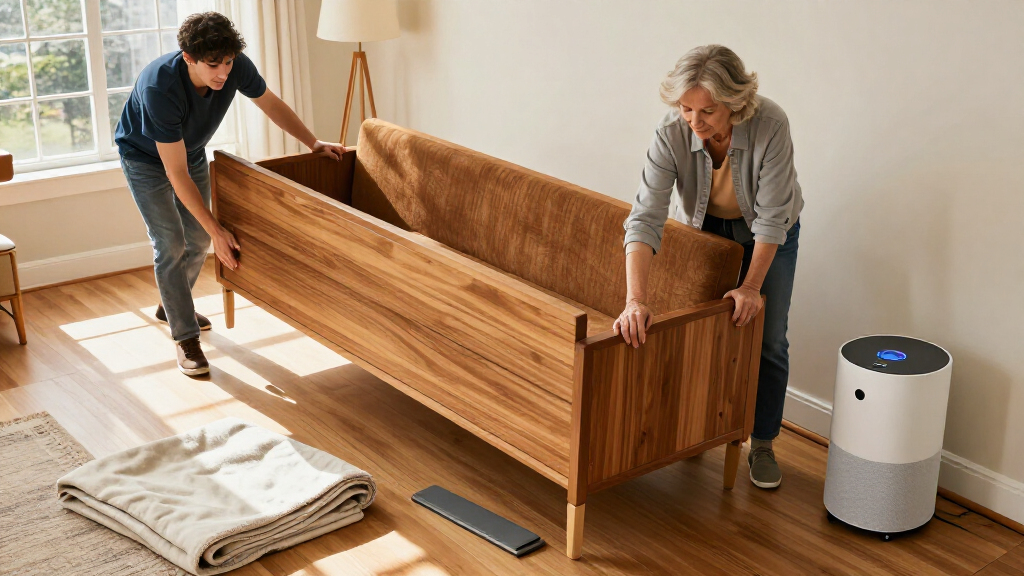
Holskey recommends getting another person to help, while both experts advise planning the route and clearing obstacles. The report also suggests using furniture sliders, dollies or lifting straps, warming up beforehand, moving items in stages, avoiding twisting and pushing rather than pulling when practical. These steps can reduce some risks, but they do not make every lift safe for every person.
The Lift Matters More Than Age
The advice offers a practical decision point for people who want to remain independent without treating age alone as a measure of ability. Strength and control vary from person to person, and the same individual may be able to handle one item but not another. A heavy piece, awkward shape, staircase or tight turn can change the risk of a move.
That distinction matters because an injury or fall can have serious consequences, while trying to manage an item without help can also put a partner at risk. The experts’ guidance is not a medical clearance: people with health concerns, pain, balance issues or cardiovascular disease may need individualized advice and should not assume that using equipment makes a strenuous lift safe.
As an affiliate, we earn on qualifying purchases.
A Task With Changing Risks
Family Handyman framed its report around everyday household work that may become more hazardous as a person’s physical abilities or health change. Its experts did not set a universal retirement age for moving furniture. Instead, Armstrong offered a strength-and-control test: if a person cannot pick an item up smoothly and carry it with full control, he said, it is too heavy for them at that time, whether they are 45 or 75.
The report’s advice centers on reducing strain and avoiding sudden, uncontrolled movements. Holskey said people often get hurt by trying to lift more than their bodies are currently trained to handle. Armstrong described twisting during a carry as a common point at which an injury can occur. The source does not cite a study or provide statistics measuring how often these injuries happen.
““There is a strength-and-control test: If you cannot pick the item up smoothly and carry it under full control, it is too heavy for you today — at 45 or at 75.””
— Zac Armstrong, strength coach
As an affiliate, we earn on qualifying purchases.
No Universal Safety Threshold
The report does not establish a specific age, weight limit or medical test for deciding who can safely move furniture. It also gives no injury-rate data and does not assess how health conditions, medications, mobility limitations or the shape of a particular item might affect an individual’s risk. Its recommendations are general guidance, not a substitute for advice from a clinician familiar with a person’s health.
Whether a move is safe can depend on the object, route, available equipment and the person’s condition on that day. The report does not specify when a helper is sufficient versus when professional movers are the safer option.
As an affiliate, we earn on qualifying purchases.
Choose Help Before Lifting
Before moving a piece, people can assess whether they can lift and carry it without pain, loss of balance or uncontrolled movement, and check the route for obstacles, stairs and tight turns. If the answer is uncertain, the experts’ advice is to ask for help or contact a professional mover; the report notes that some moving companies provide in-home furniture-moving services.
Anyone with a relevant medical condition or symptoms should seek individualized medical guidance rather than rely on a general age-based rule. The source report does not announce a forthcoming policy, study or follow-up milestone, so no further development is specified.
As an affiliate, we earn on qualifying purchases.
Key Questions
At what age should you stop moving furniture?
The experts in the Family Handyman report give no fixed age. They say the decision should depend on strength, control and the risks of the specific move.
How can I tell whether a piece is too heavy for me?
Armstrong’s guideline is that if you cannot lift an item smoothly and carry it under full control, it is too heavy for you at that time. If you feel unsure, ask for help rather than testing yourself during a difficult carry.
What steps can reduce the risk of injury?
The report recommends getting a helper, clearing the route, planning turns and stairs, and using suitable moving equipment. It also advises avoiding twisting, moving an item in stages and pushing rather than pulling when practical. These measures do not guarantee a risk-free move.
When should I hire professional movers?
If you cannot control the item, feel uncertain about your ability, or face a difficult route, consider asking for assistance or hiring professionals. The report also cautions that strenuous lifting may pose serious risks for people with cardiovascular disease.
Source: rss
Cold & flu season Picks
humidifiers
As an affiliate, we earn on qualifying purchases.