TL;DR
House Beautiful’s 2026 Whole Home in Charleston features wallpaper in several compact bathrooms, using texture, botanical pattern and brick-like imagery to add character. The examples show design approaches, not proof that wallpaper works in every bathroom; suitability depends on the product, installation and room conditions.
House Beautiful’s 2026 Whole Home in Charleston uses wallpaper in several small bathrooms to bring in texture, pattern and visual detail, making wallcoverings the report’s featured design approach for compact spaces. The rooms offer examples from designers, rather than evidence that wallpaper suits every bathroom or will make a room physically larger.

Get home appliances delivered free with Prime
- Fast, free delivery on millions of items
- Prime Video, Amazon Music and more included
- Member-only deals all year
In a guest bath, Birmingham designer Mark Kennamer carried the vanity’s soft pink color onto the walls and ceiling, pairing the nearly monochromatic scheme with a mauve moiré wallcovering by Zoffany. House Beautiful describes the material as adding a subtle shimmer and wood-like grain. The example relies on surface texture and tonal variation rather than a high-contrast print.
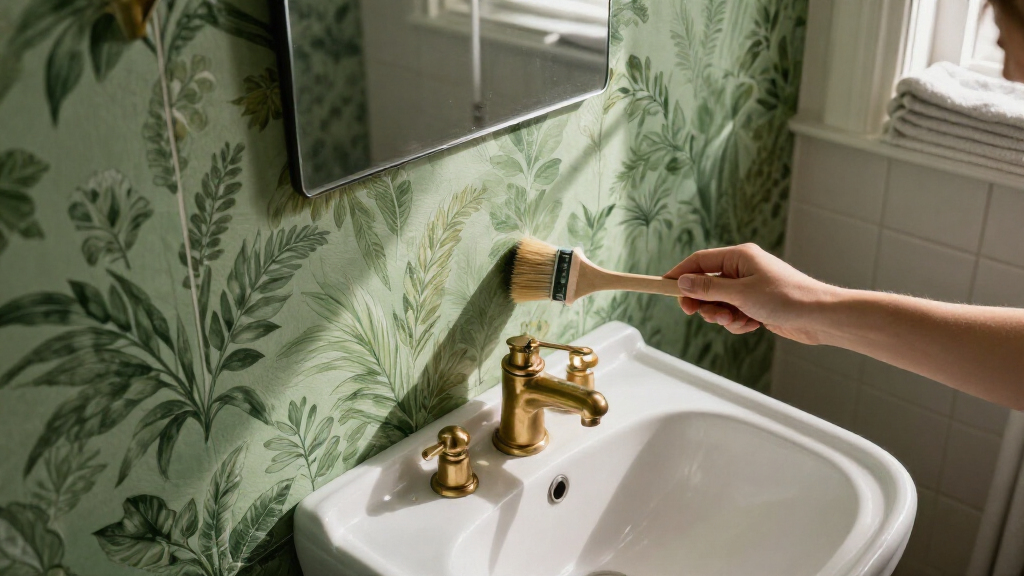
For the primary bathroom, Anissa Zajac of House Seven Design chose a botanical wallcovering by Sanderson. Its pattern brings together colors from the room’s palette, while vertical lines echo the fluted vanity cabinets. The report presents that coordination as a way to make a bold pattern feel connected to the rest of the design.
A third room, the gallery bath, was designed by R&R Interior Design 365. The team used blue-brick wallpaper by Perennials, drawing on Charleston’s cobblestone streets as inspiration. House Beautiful says the look was intended to give the bathroom a warm, intimate feel without using exposed brick. The report does not provide product specifications, installation details or performance results for the examples.
How Pattern Shapes a Compact Bath
Small bathrooms often have limited wall area and few places for decorative objects. Wallpaper gives designers a way to use that existing surface for color, texture or pattern, rather than relying only on fixtures and accessories. The Charleston rooms illustrate three distinct choices: a restrained tonal texture, a coordinated botanical print and a material-inspired image.
For readers planning a renovation, the examples show that wallpaper need not mean covering a room in a busy print. A subtle finish can add visual depth, while a larger pattern can connect colors or repeat shapes already present in cabinetry. These are design interpretations of the featured rooms, not measured findings about how wallpaper affects perceived room size or resale value.
Products Worth Considering

Dyson V15 Detect Cordless Stick Vacuum

Shark Pet Cordless Stick Vacuum, Up to 40-Minute Runtime, Grey, IX141

Bose Lifestyle Ultra Wireless Home Speaker, White Smoke
As an affiliate, we earn on qualifying purchases.
Three Charleston Bathroom Approaches
The source is a design report about House Beautiful’s 2026 Whole Home in Charleston, not a product test or construction guide. Its advice centers on a familiar design tension: people working with little space may choose fewer details to avoid visual clutter, but the featured designers instead use wallcovering as a deliberate part of the room’s scheme.
Each example uses a different relationship between wallpaper and the surrounding finishes. Kennamer’s room emphasizes a shared pink tone and tactile surface; Zajac’s pairs botanical imagery with vertical cabinetry detail; and R&R Interior Design 365’s room uses a brick-like print to evoke a local streetscape. The report names the designers and wallcovering brands, but offers no comparative assessment of cost, durability or maintenance.
Durability and Installation Details
The report does not say how the featured wallcoverings perform under each bathroom’s humidity, ventilation or cleaning conditions. It also does not identify the precise product variants or explain whether special adhesives, surface preparation or protective finishes were used. Those details matter because suitability can depend on the specific wallcovering and the conditions in the room.
The article’s claim that properly installed wallcoverings are a reliable way to add flair is presented as design guidance, not as a tested performance finding. Readers should check manufacturers’ instructions and consult an experienced installer about a particular product and bathroom. The report also gives no budget figures or evidence that wallpaper makes a small room appear larger.
Check the Product Before Choosing
For anyone considering the approach, the next step is to match a wallcovering to the room’s conditions and the broader design. Check the manufacturer’s guidance for bathroom use, cleaning and installation, then compare samples with the vanity, tile and lighting. A textured, tone-on-tone option may suit a quieter scheme; a patterned design can work as a focal point when its colors or lines relate to existing finishes.
House Beautiful’s feature does not announce a further test or follow-up, so no additional performance findings are established. The practical question for a project remains whether a chosen product is suitable for that specific bathroom and can be installed according to its requirements.
Key Questions
What is the main design idea in the report?
House Beautiful’s Charleston bathrooms use wallpaper to add character through texture, coordinated color, botanical pattern or brick-like imagery.
Which designers are featured?
The rooms were designed by Mark Kennamer, Anissa Zajac of House Seven Design, and the team at R&R Interior Design 365.
Does the report show that wallpaper makes a bathroom look bigger?
No. It offers design examples but provides no measured evidence that wallpaper makes a small bathroom appear larger.
Can any wallpaper be used in a bathroom?
The report does not establish that every product is suitable. Check the specific wallcovering’s manufacturer guidance and ask an experienced installer about humidity, ventilation and cleaning needs.
Source: housebeautiful.com