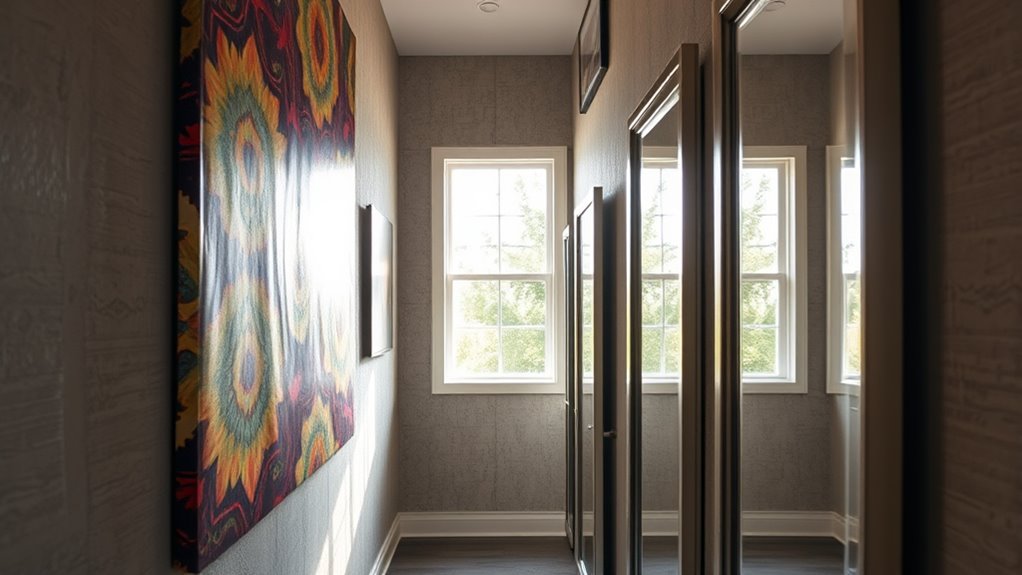
To create depth in narrow rooms, strategically place large mirrors opposite windows or light sources to reflect natural light and make the space feel larger. Use wall art featuring landscapes or perspective scenes to add visual interest and depth, hanging pieces slightly above eye level to guide your gaze upward. Keep frames simple and colors light for an airy feel. Balancing these elements helps transform a cramped space into an inviting, open environment—explore further to master these techniques.
Key Takeaways
- Place large mirrors opposite windows or light sources to reflect brightness and visually expand the space.
- Hang vertically oriented mirrors to emphasize ceiling height and create a sense of openness.
- Use landscape or perspective-themed wall art positioned slightly above eye level to add depth.
- Keep wall art simple, impactful, and cohesive in color to avoid clutter and enhance spatial perception.
- Arrange mirrors and artwork to achieve visual balance, guiding the eye and making the room appear wider and more inviting.

When you’re trying to make a narrow room feel more spacious, incorporating wall art and mirrors is one of the most effective strategies. These elements work together to create powerful spatial illusions that trick the eye into perceiving more depth and width. By carefully choosing and positioning your wall art and mirrors, you can enhance the sense of openness without any major renovations. The key lies in understanding how visual balance influences perception. When you achieve a harmonious distribution of visual weight, the room feels more inviting and less cramped.
Mirrors are your best allies in this effort. Placing a large mirror on one wall reflects the room back into itself, instantly doubling the perceived space. Position it opposite a window or light source to maximize natural illumination, which further amplifies the feeling of openness. Consider using elongated or vertically oriented mirrors to draw the eye upward, emphasizing height and making the ceiling seem higher. This vertical emphasis creates a natural focal point, directing attention away from the room’s narrow width.
Wall art, when chosen thoughtfully, complements mirrors by adding depth and personality. Use artwork that features landscapes or scenes with a sense of depth, such as horizon lines or perspective drawing, to enhance spatial illusions. Hang art slightly above eye level to draw the gaze upward, which can make the ceiling seem higher and the room more expansive. Balance is vital—avoid overcrowding walls with too many small pieces, which can clutter the visual space instead of expanding it. Instead, opt for a few large, impactful pieces placed strategically to anchor the room’s visual flow.
The color and framing of your wall art and mirrors also matter. Light-colored frames and artwork reflect more light, contributing to an airy feel. Conversely, dark frames can add weight and might make the space feel more confined if overused. Keep the framing simple and sleek to avoid breaking the visual line and creating unnecessary clutter. You’re aiming for a cohesive look that guides the eye smoothly across the room.
Furthermore, understanding the importance of visual balance helps you create a harmonious look that enhances the perception of space. Ultimately, by combining well-placed mirrors with thoughtfully chosen wall art, you set up a visual balance that tricks the eye into perceiving more space. It’s about creating a harmony where each piece contributes to a sense of depth and openness. When you master this balance, your narrow room transforms into a brighter, more expansive space—one that feels larger than its actual dimensions.
Top picks for "creat depth wall"
Open Amazon search results for this keyword.
As an affiliate, we earn on qualifying purchases.
Frequently Asked Questions
How Can Lighting Enhance the Depth Created by Wall Art and Mirrors?
Lighting effects can markedly enhance the depth created by wall art and mirrors in your space. Use ambient lighting to evenly illuminate the room, making it feel larger, while accent lighting highlights specific art pieces or mirrors, adding layers of visual interest. Positioning lights strategically can cast subtle shadows and reflections, amplifying the sense of depth and making your narrow room feel more spacious and inviting.
What Are the Best Colors to Use for Visual Depth in Narrow Rooms?
You should choose colors with strong contrasts and carefully consider hue selection to add visual depth. Opt for darker shades on one side and lighter hues elsewhere to create dimension, making the space feel more expansive. Incorporating bold color contrasts between walls, art, and mirrors further enhances depth. Avoid monochromatic schemes, as they tend to flatten the space, and instead use a mix of contrasting colors to make your narrow room feel more open and layered.
How Do Different Mirror Shapes Affect Room Perception?
Different mirror shapes can markedly influence your room perception. Oval and elongated mirrors add a sense of height, making your space seem taller. Round mirrors soften the edges, creating a more open feel. Rectangular and square mirrors provide structure and balance, enhancing depth. By choosing the right mirror shapes, you can manipulate how spacious your narrow room appears, making it feel more inviting and less cramped.
Can Artwork Placement Influence Room Size Perception?
You might think shrinking artwork makes your room feel bigger, but large-scale artwork actually enhances space perception. Placement is key—hang pieces at eye level and use mirror framing that draws the eye outward. Ironically, carefully scaled artwork and thoughtfully framed mirrors trick your mind into perceiving more room, making narrow spaces seem expansive. So, strategic artwork scale and mirror framing truly influence how spacious your room feels.
What Furniture Choices Complement Wall Art and Mirror Decor?
You should choose furniture that complements wall art and mirrors by focusing on harmony and balance. Opt for pieces with sleek lines and neutral colors to avoid clutter and enhance the visual appeal. Coordinate accessories with your decor, maintaining consistency in style and color. This approach creates a cohesive look, making the room feel more expansive and inviting while ensuring all elements work together seamlessly.
Conclusion
Think of your narrow room as a canvas waiting to be transformed. Just like a painter adds layers to create depth, incorporating wall art and mirrors can make your space feel larger and more inviting. I once helped a client hang a large mirror opposite a vibrant painting, and suddenly, the room felt twice as big—like opening a window to a wider world. With a few strategic choices, you can turn your narrow room into a stunning, spacious retreat.